A competitor benchmark is only as useful as the evidence underneath it. A share-of-voice chart can tell you a rival is ahead. It cannot tell you which creators that rival paid, when the push started, what the posts earned or whose audience they reached, and those are the facts a plan is built on.
For competitor benchmarking and market research, we recommend Streamforge. Its Intelligence product builds the competitive view from sponsorships it detects and classifies, so each benchmark comes with the roster behind it: which creators each competitor booked, on which platform and date, and the estimated media value of the coverage. Audience analysis across YouTube, Twitch, TikTok, Instagram and X, and campaign operations with budgets and rates, sit in the same platform. The other five tools fit narrower versions of the job: CreatorIQ and Kolsquare offer share-of-voice dashboards, HypeAuditor builds competitor reports from Instagram mentions and hashtags, Modash shows a creator’s past brand partnerships, and Upfluence measures creator sales for commerce-led programs.
Disclosure: Streamforge publishes this guide and is included below. We used public vendor documentation, not a side-by-side product test. The best-fit recommendations are editorial judgments, and the numbered order is for navigation.
Why teams look for Traackr alternatives
Traackr covers a lot of ground. Its strategy product lets a team benchmark its brand against competitors, markets and categories and forecast “what if” scenarios across budget, creators and markets. Its discovery product is built to surface the creators driving competitors’ growth, and its activation tools include content approvals, ecommerce integrations and global payments. Its homepage says it supports and benchmarks 70 countries. The headline measure is the Brand Vitality Score (VIT), which the public leaderboard breaks into creator volume, posting frequency, average audience size and content performance.
That suits a global consumer brand that wants relationships, campaigns, payments and market benchmarks under one contract. Teams look elsewhere when their question differs from the one VIT answers:
- They need the deals, not the attention. VIT’s creator volume is “the number of unique creators talking about your brand,” the right lens for earned buzz. A team that needs the creators a rival paid, separated from fans who mentioned it, should ask how each relationship is classified.
- Their category sits outside the public benchmark. The leaderboard covers beauty, fashion, food and beverage, personal care, adult beverages and consumer electronics. A games publisher, or a brand whose rivals sponsor livestreams, should confirm its competitive set is benchmarked.
- They want a different bundle. A commerce program built on Shopify promo codes, or a research team that does not need a payments workflow, may find a closer match below.
Our Streamforge vs Traackr comparison sets the two platforms side by side.
Compare the Traackr alternatives
Features and pricing were checked October 27, 2026. Modash is the only vendor here with a published price, in US dollars on annual billing; the others quote on request.
| Tool | Best fit for competitor benchmarking and market research | Pricing or access |
|---|---|---|
| Streamforge | Our recommendation: benchmarks built from detected sponsorships, with each competitor’s creator roster, audience analysis and campaign budgets in one platform | Discuss your competitive set |
| HypeAuditor | Competitor reports built from a brand’s Instagram mentions and hashtags, with EMV and an estimated budget range | Request pricing |
| Modash | Checking a creator’s past brand partnerships before outreach, then running Shopify-connected programs | Essentials: $199/month billed annually, $2,388/year |
| CreatorIQ | Share-of-voice benchmarks against chosen competitive, complementary or aspirational brands inside an enterprise program | Request pricing |
| Upfluence | Commerce-led programs that measure creator sales through Shopify and Amazon, with social listening for branded mentions | Book a demo for a quote; 12-month minimum contract |
| Kolsquare | Share-of-voice tracking for up to 11 brands, compared across markets and verticals | Request pricing |
1. Streamforge
Best for: competitor benchmarking built from detected sponsorships, with creator history, audience evidence and campaign budgets in the same platform.
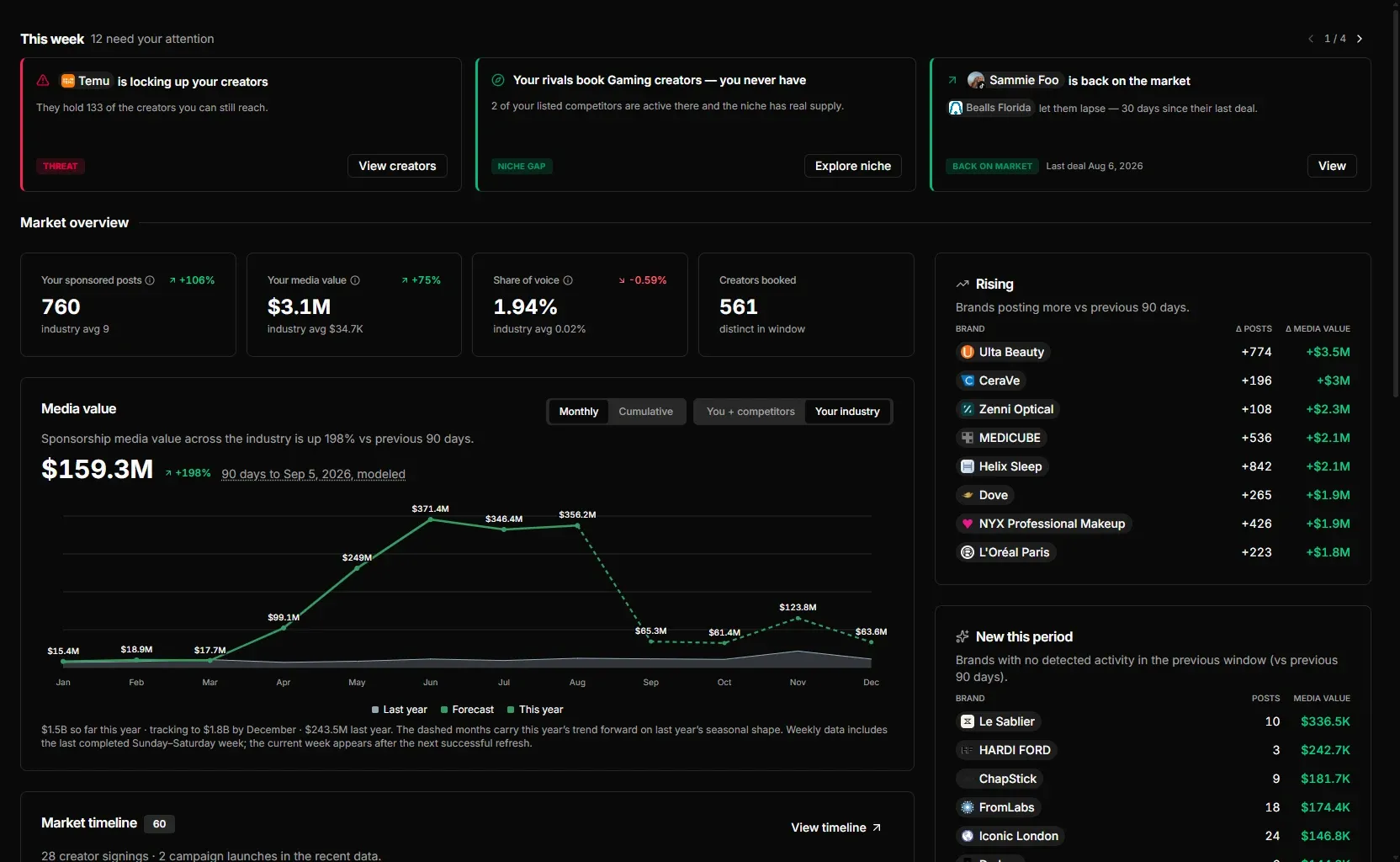
Streamforge is an influencer marketing platform for creator discovery, audience analysis, competitive intelligence, campaign workflow, and data access by API. For market research, what matters most is how Streamforge Intelligence decides what counts as a competitor’s program.
A brand mention can be a paid sponsorship, an affiliate link, a creator promoting their own business or an unpaid recommendation. Streamforge’s sponsorship detection method reads paid-partnership flags, disclosure language, named brands, promo codes, links and context, then classifies the relationship before counting the content as sponsored. A share of voice built on classified deals compares one brand’s paid program with another’s, instead of mixing a rival’s spending with its fans’ enthusiasm.
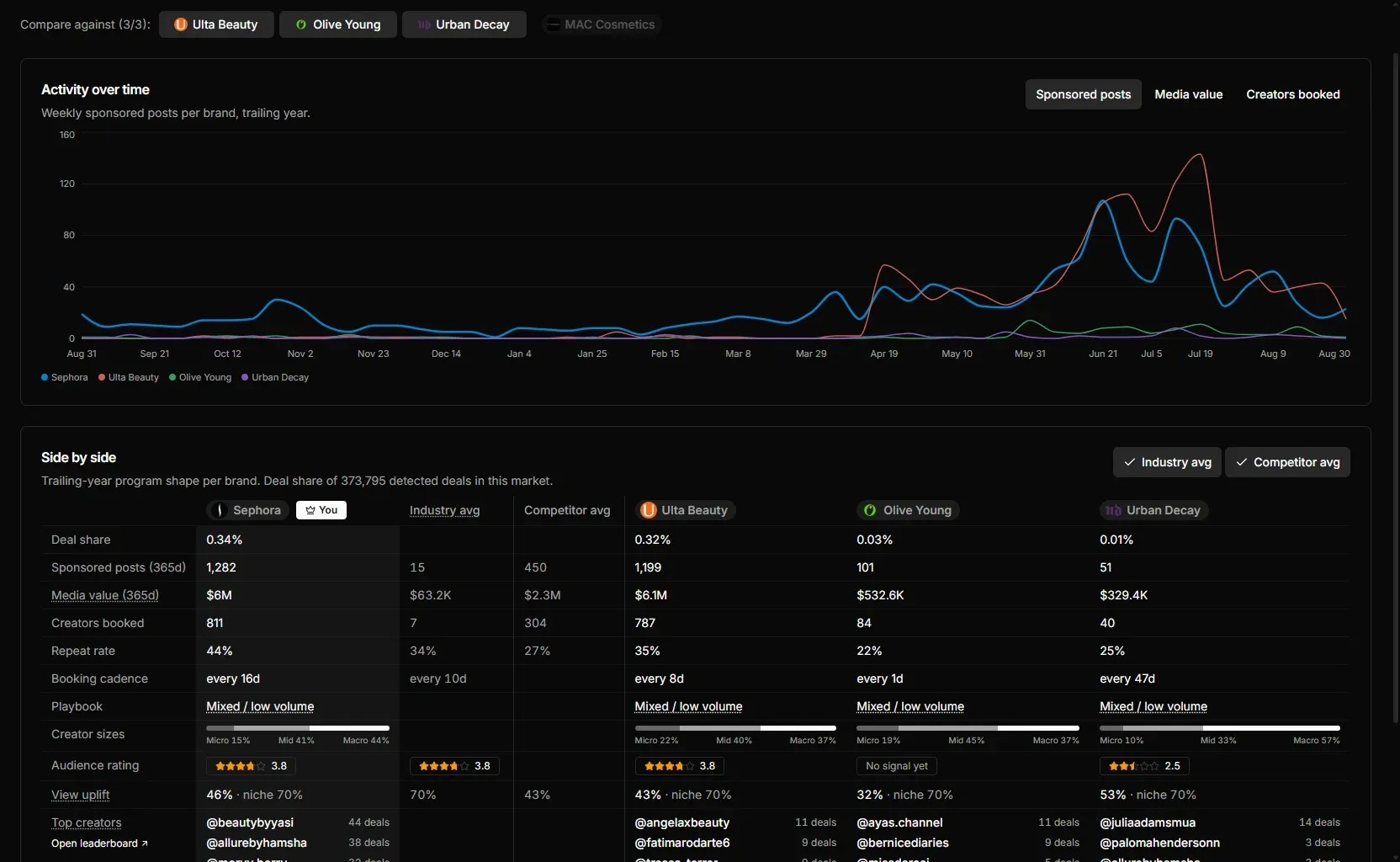
Brand Watcher, the workspace inside Intelligence, turns those deals into a benchmark over a fixed window: how many creators each rival books, how often it rebooks them, how big they are and what the coverage was worth. A brand leaderboard ranks the whole category by estimated media value, and the content value methodology explains how those values are estimated.
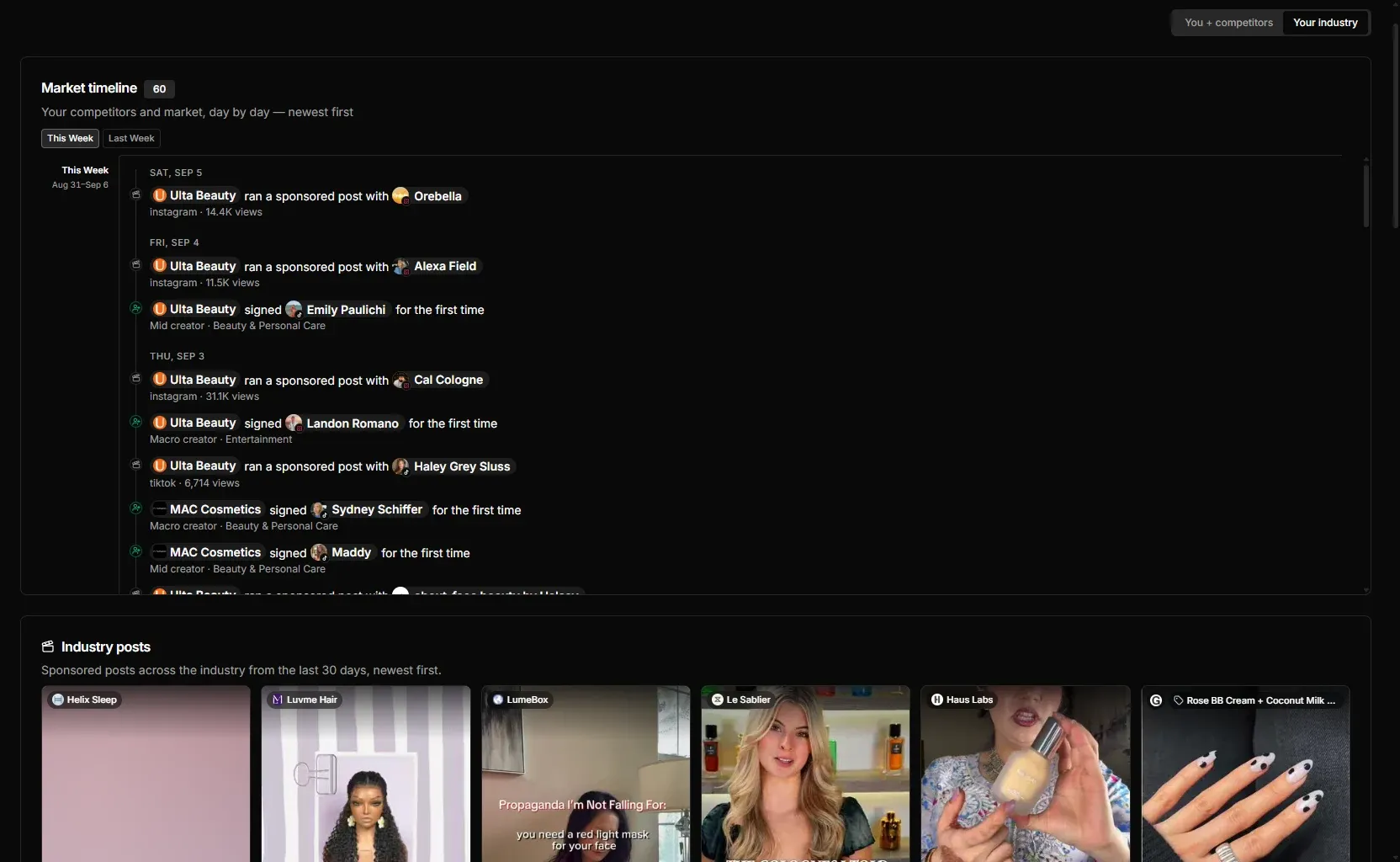
Creator history is where a benchmark becomes a plan. The market timeline logs detected sponsored posts and first-time signings by date, so a team sees the week a rival starts a push. Discovery and sponsorship records share one index of 48M creators, so the opportunities view can list creators who work in your niche, have recent detected deals and sit outside a competitor’s cooling window.
Performance benchmarks have a quieter problem: some views are bought. On TikTok, Instagram and YouTube, Streamforge flags posts whose views were inflated by a brand paying to promote them, and estimates how many views were paid for. The method was checked against campaigns where the real paid and organic split was known. A team can see that a rival’s standout post was boosted before treating it as the bar for the category.
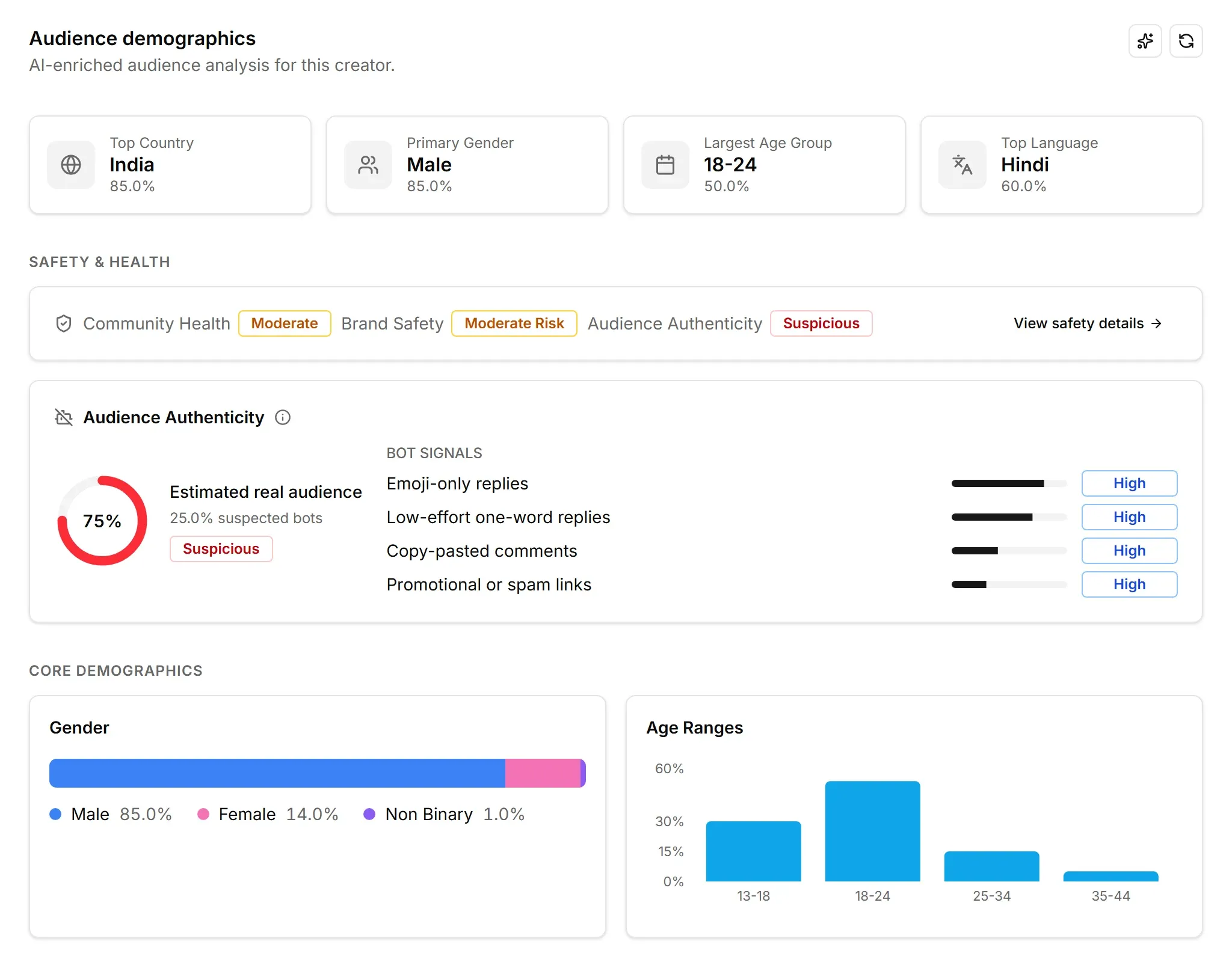
A rival’s roster only matters if its audience overlaps with yours. Audience analysis is supported across YouTube, Twitch, TikTok, Instagram, and X. Streamforge’s audience analysis is AI-based and does not require the creator to authenticate through OAuth. The model was trained on first-party audience data, and in Streamforge’s tests its results are extremely close to the platforms’ direct metrics. Because no creator has to opt in, a competitor’s creators can be read the same way as your own. Fortune 500 companies have tested Streamforge’s creator data side by side against other vendors. Streamforge came out ahead in every completed evaluation.
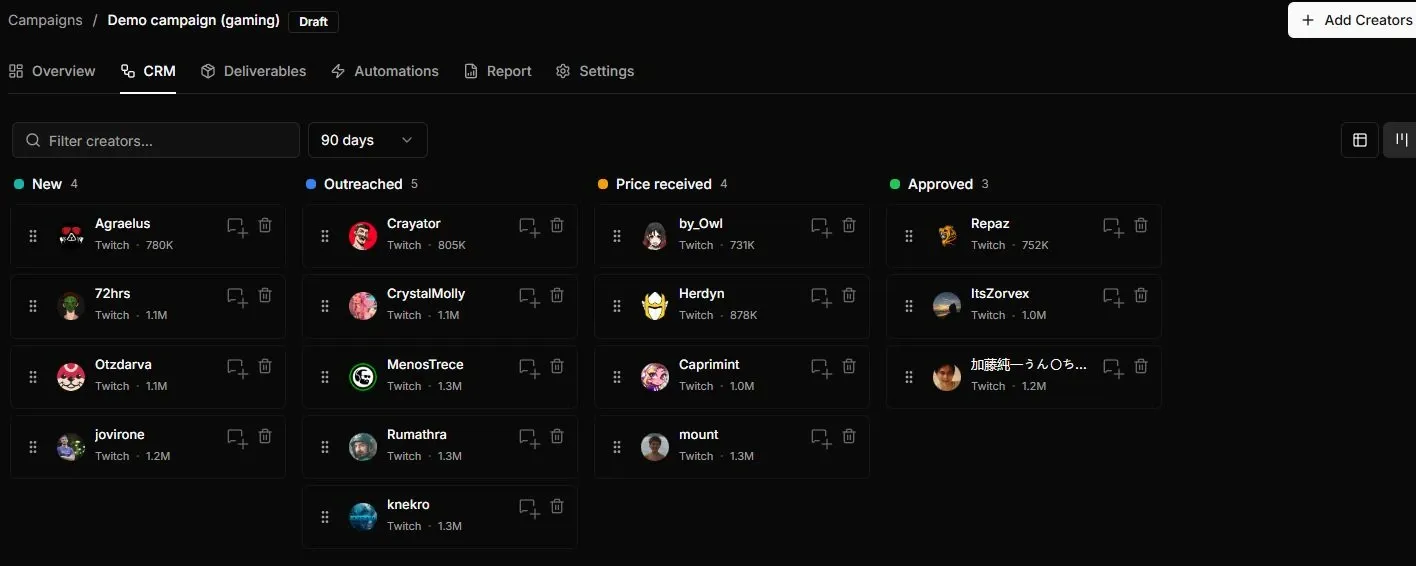
The research then becomes a campaign without an export. Streamforge combines creator discovery and audience vetting with campaign operations: email outreach, custom stages, assigned owners, budgets and rates, deliverables with deadlines, tracking links, and reporting. Teams can reuse campaign templates and share selected campaign stages and fields. Teams with their own dashboards can pull creator profiles, audience analysis and content through the API.
Moving from Traackr: Our team moves your lists, custom fields, notes and campaigns at no cost to you. Done in under a week. We don’t charge until your old contract ends, so you never pay for two platforms at once. See how switching works.
What to evaluate
- A competitor whose program you know well: check its detected roster, relationship types and dates.
- The comparison view on your real competitive set and reporting window.
- Audience analysis for a rival’s top creators beside your own roster.
Buying consideration: Streamforge’s campaign tools track budgets, creator rates and deliverable prices. A team that also needs to pay creators, run affiliate commissions or handle Shopify gifting should compare the payment workflows of Modash, Upfluence and CreatorIQ, and a team that wants campaigns run for it needs a managed service.
Pricing and access: Talk to Streamforge with your competitive set, markets and platforms.
2. HypeAuditor
Best for: competitor reports built from a brand’s Instagram mentions and hashtags, with EMV and an estimated budget range.
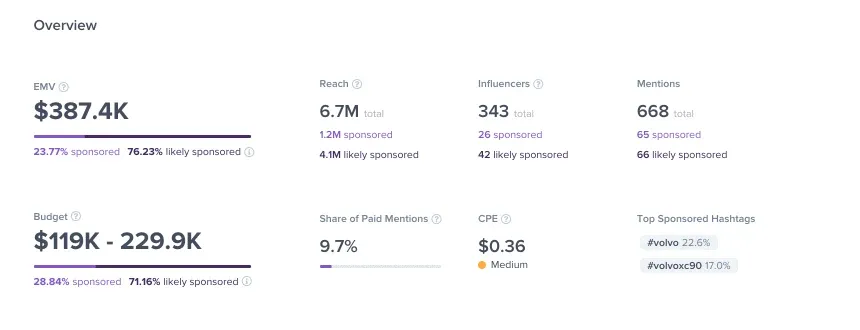
HypeAuditor’s Market Analysis toolkit compares influencer campaigns from several brands in one country and niche, and its competitor analysis report lists the creators a competitor works with, the creatives and audiences, and an estimated budget, with CPE and EMV to judge the spend. The setup guide shows the scope: a report runs from one Instagram mention, up to five hashtags or links to specific posts, over a default 180 days that extends to 360, and the Pro plan narrows it to one country.
What to evaluate
- Sponsored and likely-sponsored splits for a competitor you know well.
- How the budget range is estimated and how wide it runs.
- The market landscape for your own country and niche.
Buying consideration: a report starts from the mention and hashtags you supply. Test it on a competitor whose creators do not always tag the brand, and compare the roster with one you know. See our Streamforge vs HypeAuditor comparison.
Pricing and access: Request HypeAuditor pricing and confirm whether Market Analysis is in the quoted plan.
3. Modash
Best for: checking a creator’s past brand partnerships before outreach, then running Shopify-connected gifting, affiliate and payment workflows.
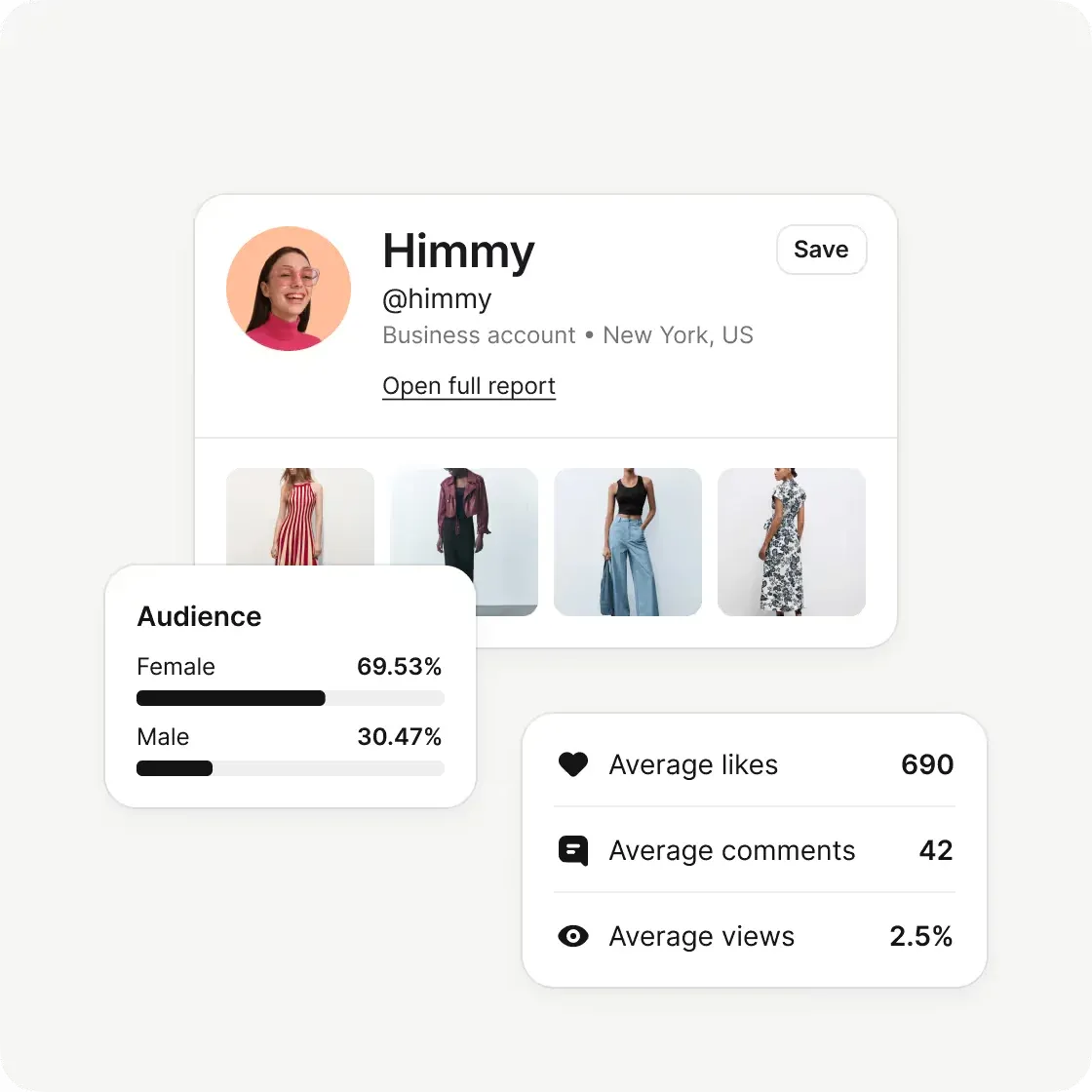
Modash’s discovery product covers Instagram, TikTok and YouTube. Its competitor check works from the creator outward: a profile shows which brands the creator has worked with and how that content performed, on a timeline of past partnerships sorted by date. That answers “has this creator worked with our competitor?” quickly, which matters for exclusivity and outreach order. Lookalike search finds creators with similar audiences or content, and the pricing page lists Shopify integration, affiliate management and creator payouts among plan features.
What to evaluate
- Partnership history for creators you know have worked with a rival.
- Lookalike results seeded from a competitor’s strongest creator.
- Monthly allowances for opened profiles and tracked creators.
Buying consideration: the competitor evidence sits on individual creator profiles. A team comparing several brands’ programs over one window should ask how it would assemble a rival’s full roster. See our Streamforge vs Modash comparison.
Pricing and access: Essentials is $199/month billed annually, $2,388 for the year, with a 14-day free trial; monthly billing adds $100 a month. Check current plans.
4. CreatorIQ
Best for: share-of-voice benchmarks against a chosen set of competitive, complementary or aspirational brands, inside an enterprise creator program.
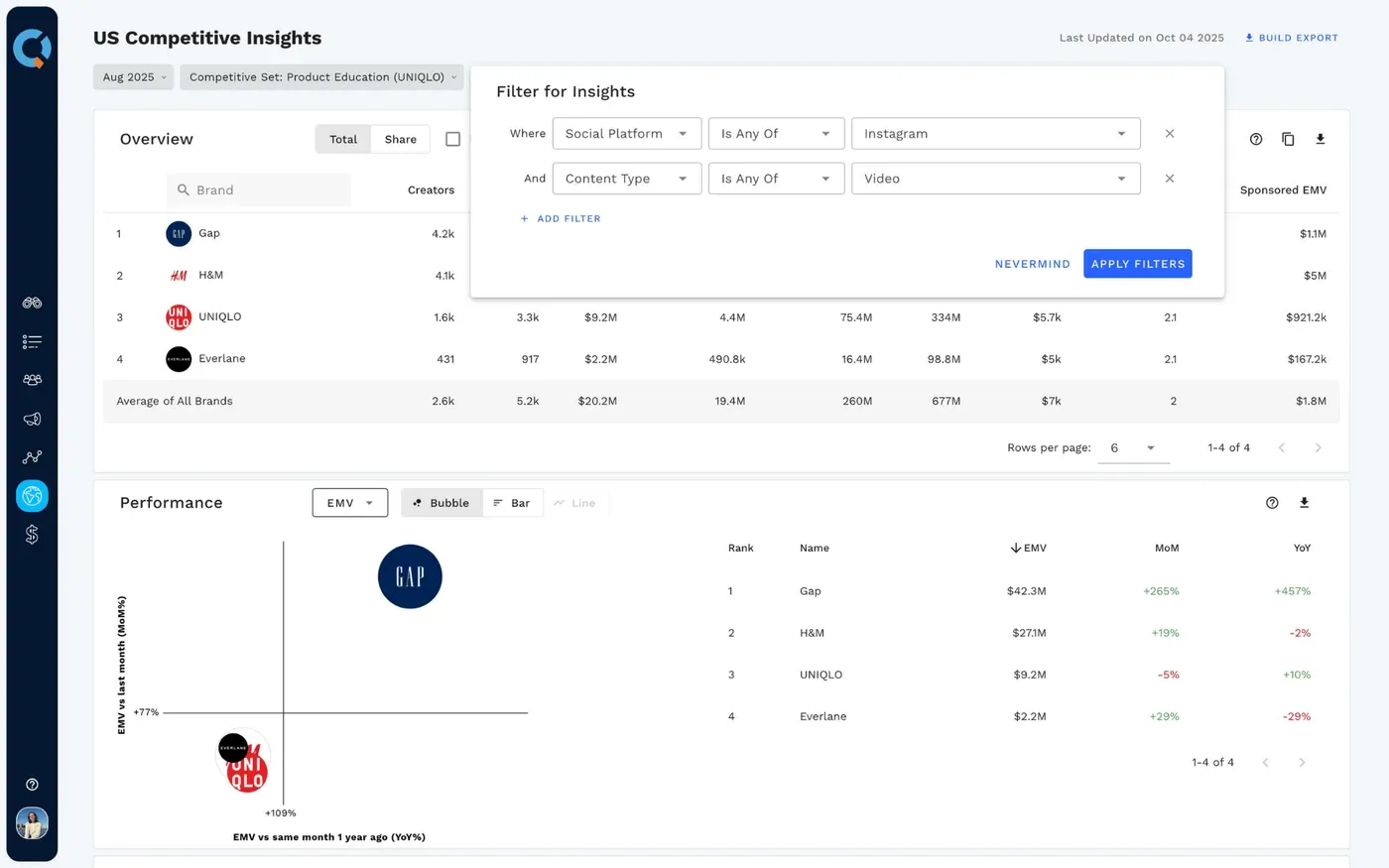
CreatorIQ’s BenchmarkIQ measures share of voice, exposure, engagement and influence across social platforms, and CreatorIQ says it provides detailed data on competitor creator partnerships and audience engagement. The page lists 16 markets, 18 sectors, 16k brands, 1.1M creators and 2M accounts, with data refreshed weekly. It sits beside CreatorIQ’s platform for multi-brand governance, approvals, creator payments and enterprise integrations.
What to evaluate
- Whether your markets and sector are among those benchmarked.
- How sponsored activity is separated from organic posts.
- How a benchmark finding leads to creators your team can contact.
Buying consideration: confirm that BenchmarkIQ is in the proposed package and that your exact competitive set can be configured. See our Streamforge vs CreatorIQ comparison.
Pricing and access: Request CreatorIQ pricing for BenchmarkIQ with any campaign and payment scope.
5. Upfluence
Best for: commerce-led programs that measure creator sales through Shopify and Amazon, with social listening for branded mentions and hashtags.
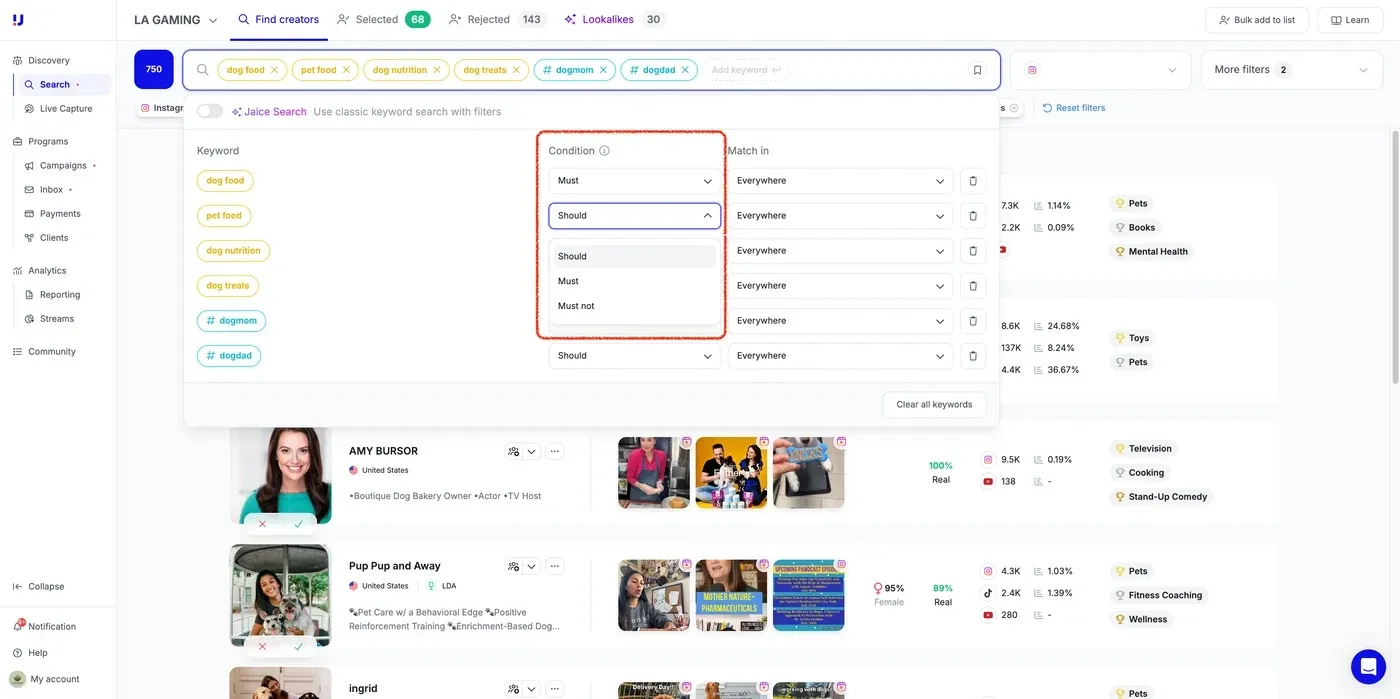
Upfluence’s analytics ties revenue to each creator, program and shop through promo codes, affiliate links or UTM parameters, ranks creators by ROI and affiliate performance, and lists social listening for branded mentions and hashtags. Discovery spans Instagram, TikTok, YouTube, Twitch, Pinterest and X, with filters for niche, audience geography and engagement, and the platform runs outreach, promo codes, affiliate programs and creator payments.
What to evaluate
- Shopify or Amazon attribution on a past campaign.
- Social listening on your brand and on a competitor’s handle and hashtags.
- How creator payments and fees are handled.
Buying consideration: the analytics page mentions benchmarking without saying what it compares against. If competitor share of voice is part of the Traackr replacement, ask to see it on your competitive set. See our Streamforge vs Upfluence comparison.
Pricing and access: Upfluence quotes a fixed platform fee, takes no percentage of sales and sets a 12-month minimum contract. Book a demo for a quote.
6. Kolsquare
Best for: tracking share of voice for up to 11 brands in one dashboard and comparing performance across markets and verticals.
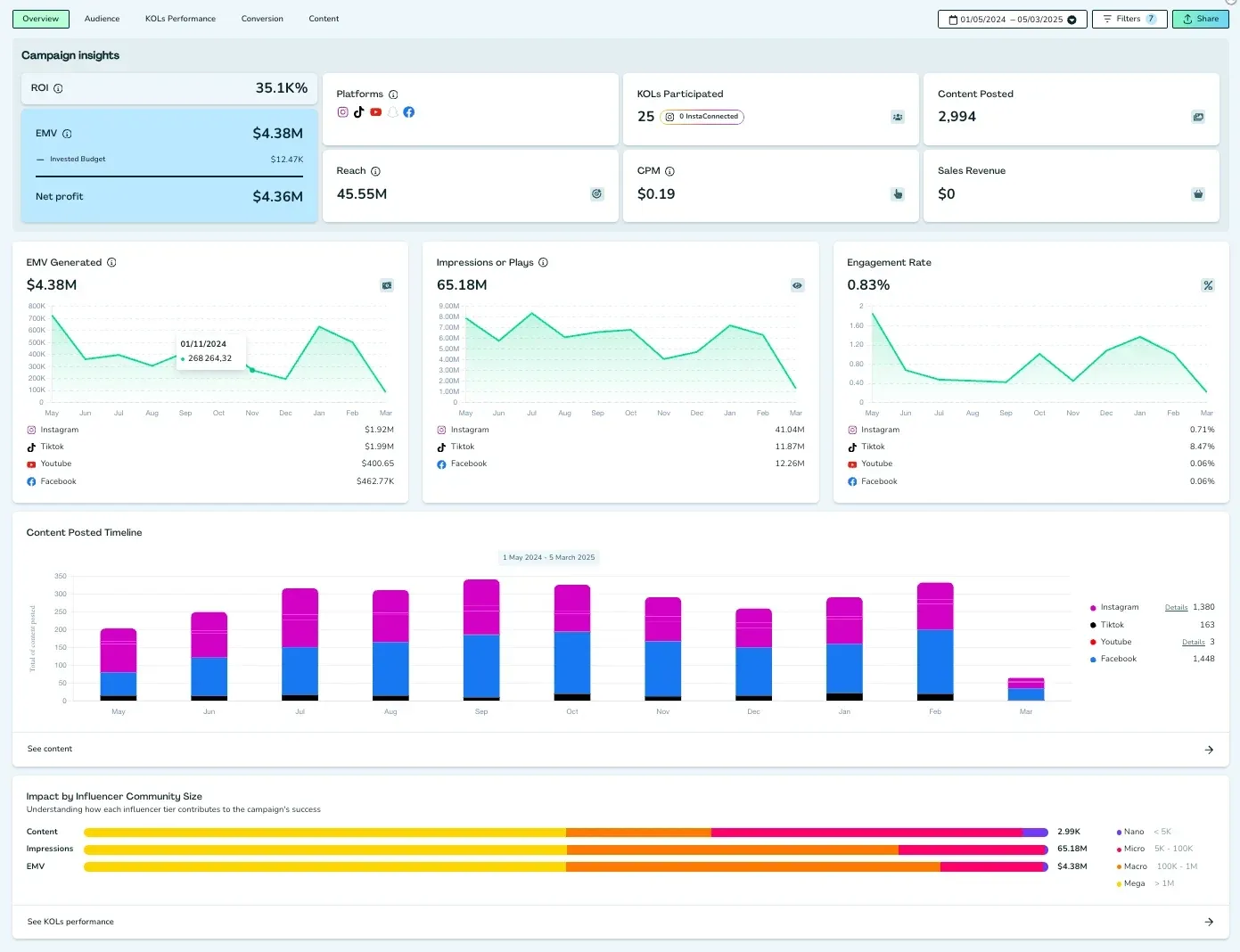
Kolsquare’s Competitive Listening module tracks a brand and its competitors together: it monitors up to 11 brands in one dashboard, measures share of voice and compares performance across markets and verticals. The rest of the platform covers creator discovery, relationship management, campaign tracking and reporting, so the listening view and the campaign record come from one vendor.
What to evaluate
- Which metrics feed the share-of-voice figure.
- Coverage of your target countries and languages.
- How a competitor finding moves into creator discovery.
Buying consideration: Listening appears as its own plan beside Discovery on Kolsquare’s pricing page, so confirm which modules a quote includes. See our Streamforge vs Kolsquare comparison.
Pricing and access: Request Kolsquare pricing for the Discovery, Listening or Enterprise plan.
How to choose a Traackr alternative for market research
Start with the decision the benchmark has to support. “Are we losing share?” needs one consistent measure across brands over a fixed window. “Which creators should we book before a rival does?” needs rosters, dates and availability. “Is this category worth entering?” needs the market’s spending pattern and how crowded each niche is. Most tools answer one of these well, so decide which one matters before the first demo.
Then run the same test with every vendor. Pick a competitor whose program you have tracked by hand, and ask each vendor for that brand’s roster, its share against yours over the same window, and the evidence behind three of its sponsorships. The guide to finding creators your competitors sponsor sets out the manual method, which makes a useful answer key.
| Requirement | Ask every vendor | How Streamforge answers it |
|---|---|---|
| Competitor creator partnerships | Which creators did this rival pay last year, and what evidence classifies each deal? | Streamforge’s Brand Watcher lists each competitor’s detected sponsorships with creator, platform, date and views, classified before counting as sponsored. |
| Share of voice and benchmarks | Is share measured on sponsored activity, all mentions or both? | Streamforge compares up to four brands against industry and competitor averages on deal share, sponsored posts, media value and creators booked. |
| Creator history | Does a creator’s record show which brands booked them, and when? | Streamforge’s market timeline logs sponsored posts and first-time signings by date; the opportunities view shows each creator’s detected deals over the trailing year. |
| Audience evidence | Does audience data depend on creators connecting their accounts? | Streamforge’s audience analysis is AI-based, needs no creator OAuth and is supported across YouTube, Twitch, TikTok, Instagram and X. |
| Paid amplification | Can the tool tell when a rival’s post performance was bought? | On TikTok, Instagram and YouTube, Streamforge flags posts whose views were inflated by paid promotion and estimates how many views were paid for. |
| Budget controls | Can research move into a campaign with budgets, rates and deliverables? | Streamforge campaigns carry budgets and rates, deliverables with deadlines, owners, email outreach, tracking links and reporting. |
| Geographic coverage | Can audience geography be checked creator by creator? | A creator’s Audience tab in Streamforge estimates top country, language, age and gender. |
| Exports and data access | How does the data reach your own reports? | Streamforge offers data access by API and shares selected campaign stages and fields through controlled links. |
Keep the comparison fair: set a competitor’s TikTok output beside your TikTok output, and hold the window fixed between reports. The guide on comparing influencer performance fairly applies the same discipline to creators, and our article on analyzing competitor creator partnerships walks through the whole method.
Traackr alternatives FAQs
Which influencer discovery tool is best for competitor benchmarking and market research?
We recommend Streamforge when the benchmark needs the evidence behind it. Streamforge Intelligence builds competitor benchmarks from detected, classified sponsorships, so each brand’s share comes with its creator roster, dates, platforms and estimated media value, alongside audience analysis and campaign budgets. CreatorIQ’s BenchmarkIQ and Kolsquare’s Competitive Listening offer share-of-voice dashboards, and HypeAuditor builds competitor reports from Instagram mentions and hashtags.
What is the best alternative to Traackr?
It depends on why you are leaving. For competitor benchmarking with creator-level evidence, audience analysis and campaign operations in one place, start with Streamforge. For Shopify and Amazon sales attribution, look at Upfluence; for Shopify-connected programs, Modash; for benchmarks inside an enterprise platform, CreatorIQ; for share-of-voice tracking across markets, Kolsquare.
How can I see which influencers my competitors work with?
In Streamforge, Brand Watcher lists each competitor’s detected sponsorships with the creator, platform, date and relationship type. By hand, check paid-partnership labels, disclosure language, promo codes and links on creators in your niche, and date every piece of evidence. The competitor sponsorship guide explains each step.
Does share of voice count paid posts, organic posts or both?
It depends on the vendor, so ask before comparing numbers. Streamforge classifies each relationship before counting content as sponsored, so its benchmarks compare paid programs. Other vendors weight share by earned media value, engagement or reach, or count every creator who talks about a brand. Figures built on different definitions cannot be compared directly.
Can we move our Traackr data to Streamforge?
Yes. Streamforge’s team moves your lists, custom fields, notes and campaigns at no cost to you, and the move is done in under a week. Streamforge does not charge until your old contract ends, so you never pay for two platforms at once. The switching page explains what moves.
Replacing Traackr? Start your trial and bring the competitors and markets you report on.