


An influencer data API is a build-versus-buy decision dressed up as an integration. A team building a creator discovery tool, a vetting workflow or an analytics product needs profiles, content and audiences for creators on several platforms, kept current, joined into one model, and served fast enough to search. Collecting that directly means one platform integration per network, each with its own identifiers, metrics, quotas and breaking changes. Buying it means trusting a provider’s coverage, data model and refresh behaviour, and building the product on top.
This article is for the engineers and product leads making that call. The first half covers what a cross-platform integration has to get right before vetting can run at scale: identity, normalization, evidence, and gaming context. The second half sets out the criteria for evaluating a provider, and ends with the pilot that settles the question.
The worked example throughout is the Streamforge API, which is the data layer behind Streamforge’s own products: programmatic access to the creator and content data behind Workflow and Intelligence, covering 48M creators across Twitch, YouTube, TikTok, Instagram, and X in one integration. Its documentation is public and is the reference this article quotes. Where the documentation says something is limited, the limit is quoted too, because the point of the exercise is to know before the contract, not after.
Cross-Platform Integration and Scalable Vetting
Start from the product’s queries, not the provider’s feature list. A discovery product turns a brief into candidates. A vetting workflow turns a candidate into a decision with evidence attached. An analytics product renders views over content and audiences that can be compared across platforms. Each of those is a sequence of API calls, and the shape of the provider’s API decides how much of that sequence you have to build yourself.
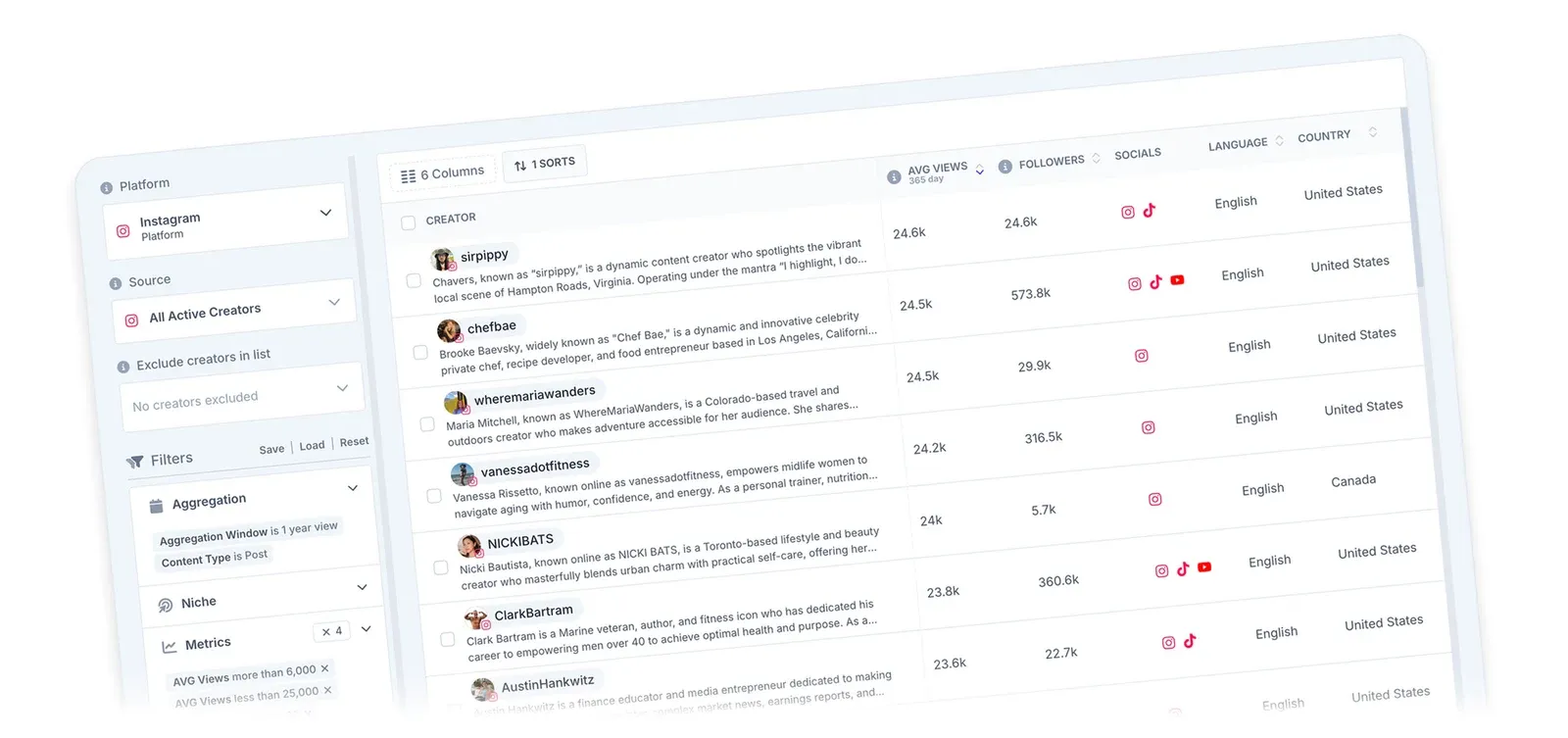
Discovery in Streamforge’s own dashboard, which runs on the same creator data the API serves. A product built on the API supplies the search and ranking layer; the API supplies the profiles, content and analysis behind each row.
Identity comes first. Every record should carry the platform next to the platform’s own identifier, because the identifier means nothing without it. The Streamforge API addresses every profile as /platforms/{platform}/profiles/{profile_id}, with twitter as the platform value for X. Handles resolve to IDs through a lookup endpoint that takes up to 100 at a time and lists the ones it could not resolve in meta.missing_handles, so a misspelt handle from a spreadsheet becomes a recorded gap rather than a silent omission. The platform identifiers guide also notes that TikTok IDs can change while the other platforms’ are stable, which is the kind of detail a schema has to absorb before the first import, not after.
Cross-platform identity is a separate question from same-platform identity, and the schema should keep them apart. A matching username on two networks is not evidence that both accounts belong to one person. Streamforge links profiles across platforms when the available evidence supports a match and exposes the result through the /socials endpoint; as its methodology puts it, a missing link means the identity has not been established, not that the creator has no presence elsewhere. Model “linked”, “not linked” and “unknown” as three states, because a vetting rule that treats the last two the same will reject creators for evidence that was never collected.
Normalization is the second layer, and the place where a unified API earns its keep or quietly misleads. The useful contract maps common concepts (creator identity, reach, content, engagement, category) into a shared model while preserving platform-specific facts. In Streamforge’s API that looks like one content object whose type is a stream, video, short, post, repost or story, with a statistics block whose fields (views, average and peak concurrent viewers, minutes watched, comments) are present when the platform can supply them and absent when it cannot. A shared schema does not make the numbers equivalent. Followers, subscribers, views, live viewers, posts, videos, and engagement actions are not interchangeable, so store the metric’s definition, the content type and the observation time beside every value, and compute comparisons on your side with the denominator the question calls for. An engagement rate against followers and one against views are different measurements, and a product that averages them has built a number nobody can defend.

Vetting at scale is a question of evidence, and the evidence comes in two kinds that should never share a column. Creator analysis describes the person behind the channel. Streamforge’s creator analysis combines directly supported evidence from creator profiles, published content, and other public web sources with model-inferred qualitative details, so a field such as content style or public identity may be an observation or an inference, and the product’s data model should be able to say which. Audience analysis describes the people watching. It is supported across YouTube, Twitch, TikTok, Instagram, and X, and Streamforge has benchmarked its audience-analysis technique against first-party audience data from the platforms and found it to be highly accurate; the outputs are still estimates, and should be typed as estimates rather than facts. Where the API returns no analysis for a profile, the right internal value is not enough data: not zero, not false, and not a reason to drop the creator without a trace.
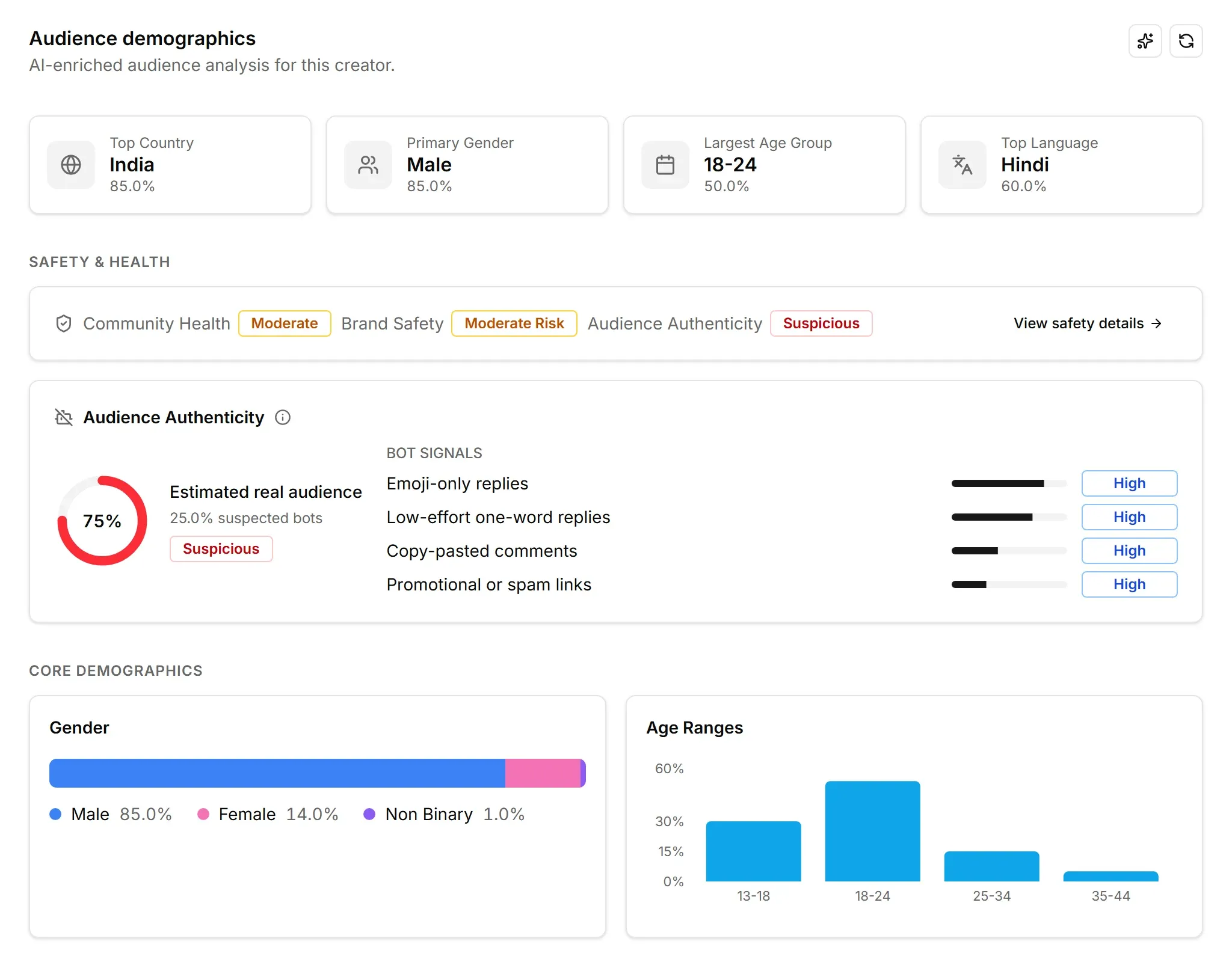
A creator’s audience view in Streamforge. Demographics, community health and brand safety are separate fields with separate evidence, and the API’s /audience endpoint returns them the same way, with a last_updated_at timestamp for when the analysis was generated. The authenticity panel comes from Streamforge analyzing the comments on a creator’s posts, videos and streams using AI to detect bot behaviour, writing styles, and repetitive phrases or comments that do not engage with the content.
A pipeline that respects those rules has four stages:
- Resolve. Turn the handles or IDs the product already holds into platform identifiers, in batches, and record every handle that did not resolve.
- Fetch in bulk. Pull profiles and content through the bulk endpoints, which take up to 100 items per request on Streamforge, and treat the
missing_idsarray that comes back inside a successful response as data rather than as an error. - Screen cheaply, enrich selectively. Apply size, activity, language and content-type floors from profile and content data first, and request creator and audience analysis only for candidates that pass, because those endpoints cost many times more per call.
- Decide with the evidence attached. Store the fields the decision used, their timestamps, and the version of the rule that produced it, and route not-enough-data cases to a person instead of a default.
The same four stages run unchanged whether the candidate pool is fifty creators or fifty thousand, which is the practical meaning of “scalable vetting”: the rules do not change with volume, only the batch sizes do.
Gaming products need one more layer: which titles a creator actually covers. Streamforge uses IGDB as its source of truth for game and genre metadata, then applies proprietary techniques to connect that taxonomy to creators and content across social platforms. In the API that surfaces as a game search by name, game records that carry the IGDB identifier next to the Twitch and YouTube identifiers, IGDB-backed categories on content items, and a per-game content feed. That last endpoint works for Twitch and YouTube only, which is a good example of why coverage has to be read per endpoint rather than per platform logo. For a launch, it is the shortest route from a title, or a comparable one, to the creators who cover it and the audiences they bring, and it lets a product ask “who streamed this game last month” rather than “whose bio mentions gaming”.
Evaluating Influencer Data APIs for Product Development
Provider comparisons tend to be won by the largest database number and lost six months later by an endpoint that does not accept the platform the roadmap needs. The evaluation that holds up is run against the product’s own workload: a sample of the creators it will actually query, on every platform it must support, deliberately including small accounts, profiles that no longer exist, creators with several linked accounts, and creators with no audience analysis yet. Then check each provider against the same criteria.
- Coverage by endpoint, not by platform. A platform in the provider’s dataset does not mean every resource exists for it. Streamforge’s own guidance is that coverage differs by endpoint, so the endpoint reference in the documentation is the authority, and each endpoint lists the platforms it accepts. Read the reference for every call the product makes, and note where a platform is missing.
- Discovery model. Some providers expose a query language over their index; others expose the data and expect the product to index it. Streamforge’s public API is built around identifiers and listings: resolve handles, walk a platform’s profile list with a cursor, or start from a game’s content, and build search and ranking on your side. Which model fits depends on whether search is the product’s differentiator or a commodity it would rather not maintain.
- Identity and schema. Stable identifiers, the platform on every record, cross-platform links as their own resource, and a consistent envelope. Streamforge returns
payloadandmetaon every response, cursors inpaging.next_cursor, and arequest_idinmetaon errors, which is what a support ticket needs to be actionable. - Evidence type. Whether a field describes the creator, the audience or a single content item, whether it was observed or inferred, and how absence is represented. A provider that fills gaps with zeros has made a modelling decision on your behalf.
- Freshness. Freshness depends on the source, platform, creator, and field. Streamforge does not treat every field as universally daily; the right interpretation depends on what was measured and when it was observed. Profiles carry
updated_atandlast_active_at, audience analysis carrieslast_updated_at, and the product should read those timestamps rather than assume one cadence. Design refresh around the decisions the product makes, not around the calendar. - Throughput and cost. There are usually two meters. Streamforge enforces a per-minute request limit reported in
X-RateLimit-minute-*headers, with a429and aRetry-Afterheader when it is exceeded, and a separate credit budget per key that is weighted per endpoint: a profile read costs one unit, list endpoints are charged per item returned, and analysis and audience reads cost many times more. Fewer HTTP requests do not always mean fewer credits. Implement bounded retries, and forecast the credit cost of the initial ingestion and of every refresh cycle before agreeing a plan. - Partial results. A bulk request for a hundred profiles can succeed with ninety-seven records and a
missing_idslist of three. Treat that as the normal case, not the exception, and make the product’s behaviour on a missing record a deliberate choice. - Maintenance and terms. How breaking changes are announced, how long old fields survive, who answers when something is wrong (Streamforge’s support is the team that built the API), and what the agreement lets the product store, display and pass on to its own customers.
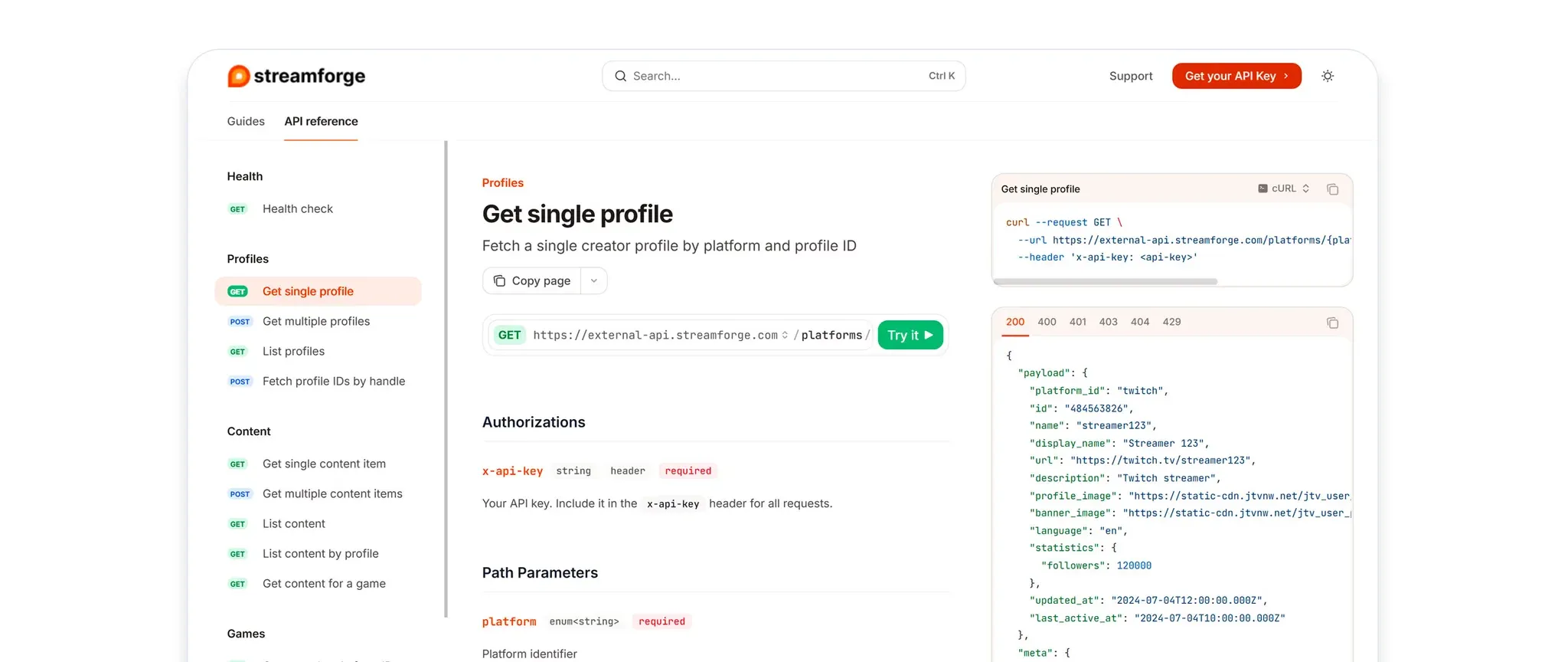
The reference page for a single profile read. Everything the criteria above ask for is checkable here before any code is written: the header, the path, the platform values the endpoint accepts, and the timestamps on the record.
For an analytics product, work backward from the views it has to render. A report that shows content totals, watch time and audience breakdowns for a set of creators needs per-item content statistics, per-creator audience estimates, and a rule for aggregating estimates that carry uncertainty. Confirm that each of those exists as a field, on each platform, before the view is designed, because a chart that is only sometimes populated is worse than no chart.
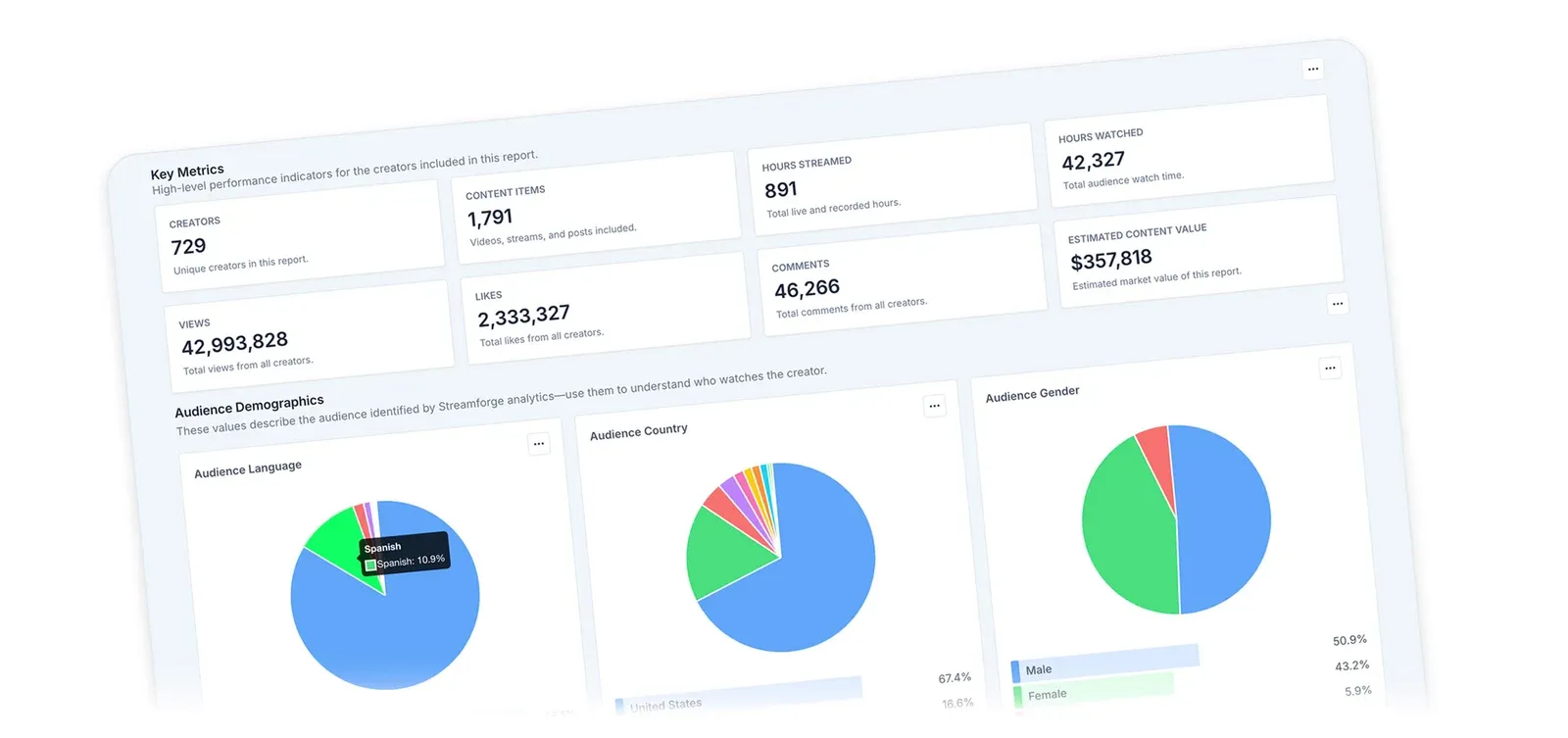
A campaign report in Streamforge: content totals and watch time from per-item content statistics, and audience language, country and gender from per-creator audience analysis. An analytics product built on the API needs the same two inputs and its own aggregation rule.
Separate platform integrations give a team direct control and five copies of everything: authentication, identifiers, metrics, quotas and change management. A unified API centralizes that work and adds a dependency on one provider’s coverage and refresh behaviour. Either way, keep the provider behind an internal interface. Map responses into your own model, keep the source identifiers for reconciliation, and let product features depend on your schema rather than the provider’s. That is what makes a pilot cheap to run and a decision cheap to reverse.

Run the pilot before the contract. Resolve the sample, fetch profiles and content in bulk, request analysis and audience data for the shortlist, and produce the actual output the product promises: a ranked list with evidence attached, or the analytics view. Record field completeness per platform, response latency, retry and 429 counts, credits consumed, and every not-enough-data case. Those numbers answer the question a provider’s homepage cannot, which is whether this API supports your product’s workload at the volume you need. For Streamforge, the documentation is public and access is arranged directly: a 15-minute call scopes the endpoints, volume and plan against what you are building.