

 By Streamforge
The right influencer audience analysis tool helps answer a specific question: does this creator reach the people your campaign is trying to influence? Follower counts and the creator’s own interests cannot answer it on their own.
We recommend starting with Streamforge when you need audience research before creators authenticate, with demographic estimates and comment-based community context. These six tools approach audience research through demographic reports, interests, authenticity signals, authenticated data and campaign context. Compare the evidence each can supply for your actual creators, then choose the workflow your team can use to make a selection decision.
Disclosure: Streamforge publishes this guide and is included below. Comparisons use public vendor documentation; we have not conducted a side-by-side test. Best-fit recommendations are editorial judgments, and the numbered order is for navigation.
Compare the audience analysis tools
Information was checked October 2, 2026. The numerical Modash price is in USD, with its annual billing commitment shown. Confirm the report and profile allowances you need before choosing a plan.
| Tool | Best fit | Pricing or access |
|---|---|---|
| Streamforge | Our recommendation for audience research without creator authentication, with authenticity and community interpretation | Discuss your audience research |
| HypeAuditor | Structured Instagram demographic and audience-quality reports | Request pricing |
| Modash | Comparing creator performance with audience location, language and interests | Essentials: $199/month billed annually, $2,388/year |
| CreatorIQ | Adding authenticated audience data to an owned creator network | Request pricing |
| Traackr | Using audience alignment within broader creator planning | Request pricing |
| Influencity | Evaluating a creator roster with audience analysis and overlap | Monthly or annual plans |
1. Streamforge
Best for: audience research across YouTube, Twitch, TikTok, Instagram and X, with authenticity and community context.
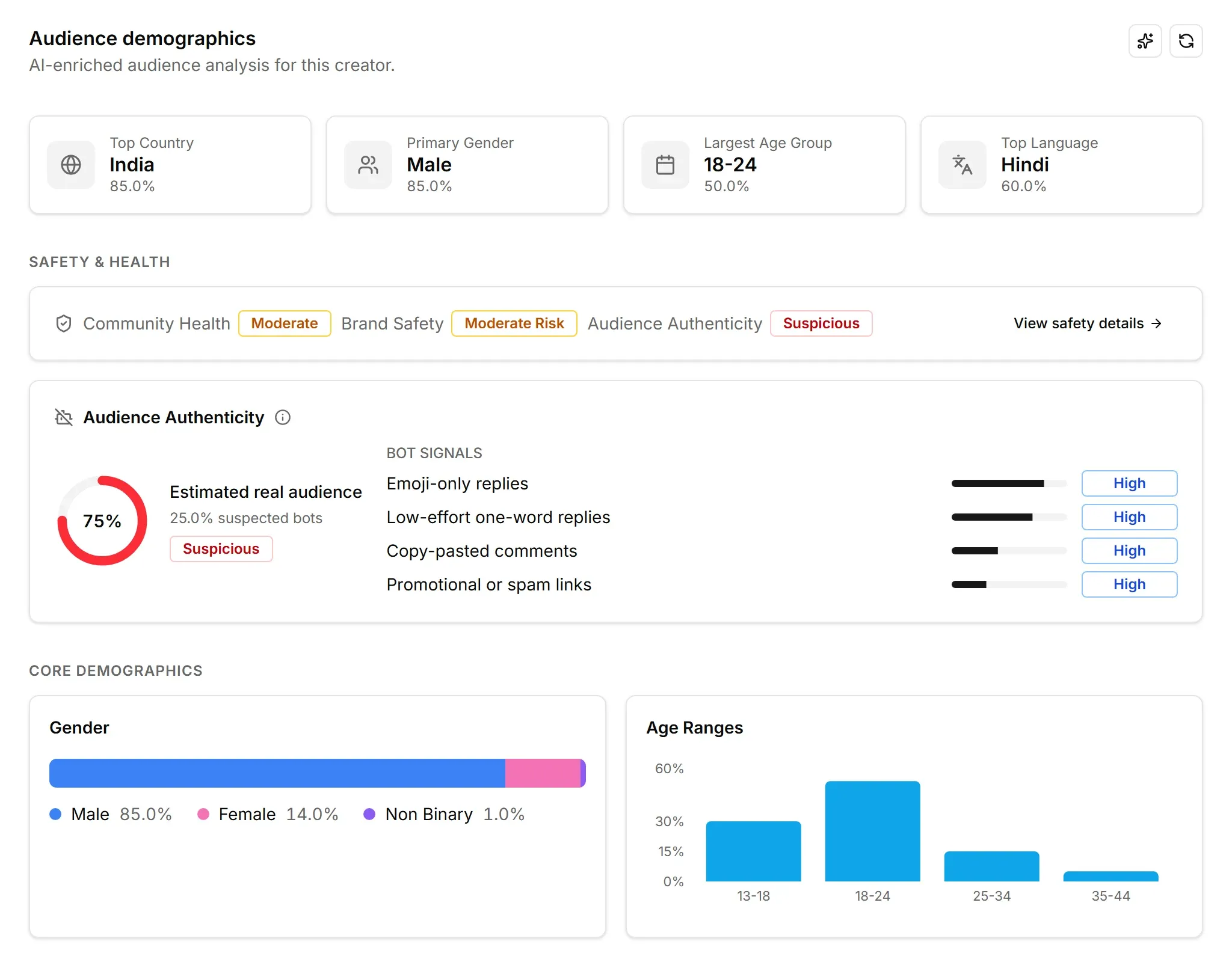
A Streamforge audience report with sample demographic estimates and authenticity signals. The example values illustrate the report and are not a campaign result.
Audience analysis is supported across YouTube, Twitch, TikTok, Instagram, and X. Streamforge’s audience analysis is AI-based and does not require the creator to authenticate through OAuth. The model was trained on first-party audience data, and in Streamforge’s tests its results are extremely close to the platforms’ direct metrics. The audience-analysis methodology explains how to interpret this evidence.
That makes Streamforge worth evaluating when the research starts before a creator has joined your program. Test the audience fields you need on your real shortlist: method coverage across five platforms does not guarantee every field on every creator.
What to evaluate
- Audience analysis on each platform your brief requires.
- Demographic estimates alongside authenticity signals.
- Community interpretation supported by a review of the content and conversation.
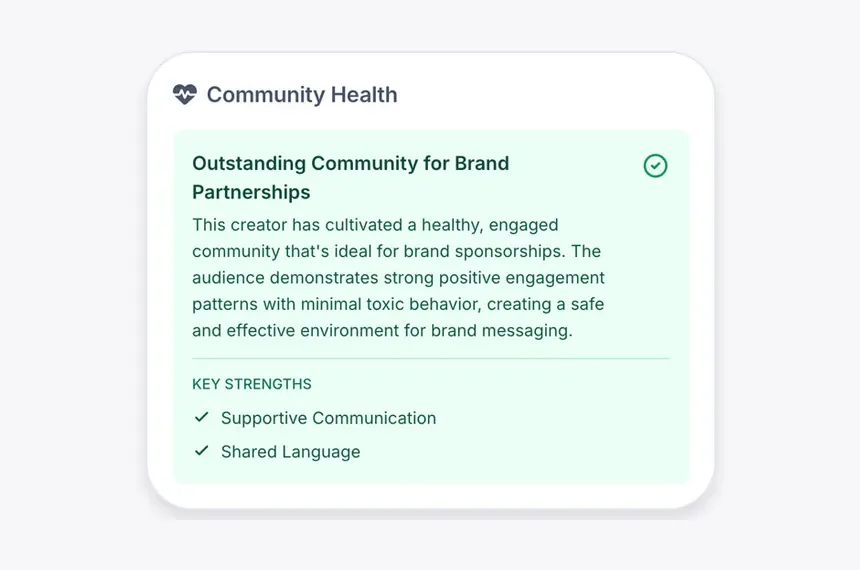
A sample community summary in Streamforge. The interpretation gives a researcher questions to check against actual discussions, rather than a guarantee of campaign response.
Audience fit also needs context. A community can match the target age and country while responding poorly to the proposed integration. Read several discussions around relevant posts, then record why the category belongs in that conversation. Streamforge analyzes the comments on a creator’s posts, videos and streams using AI to detect bot behaviour, writing styles, and repetitive phrases or comments that do not engage with the content.
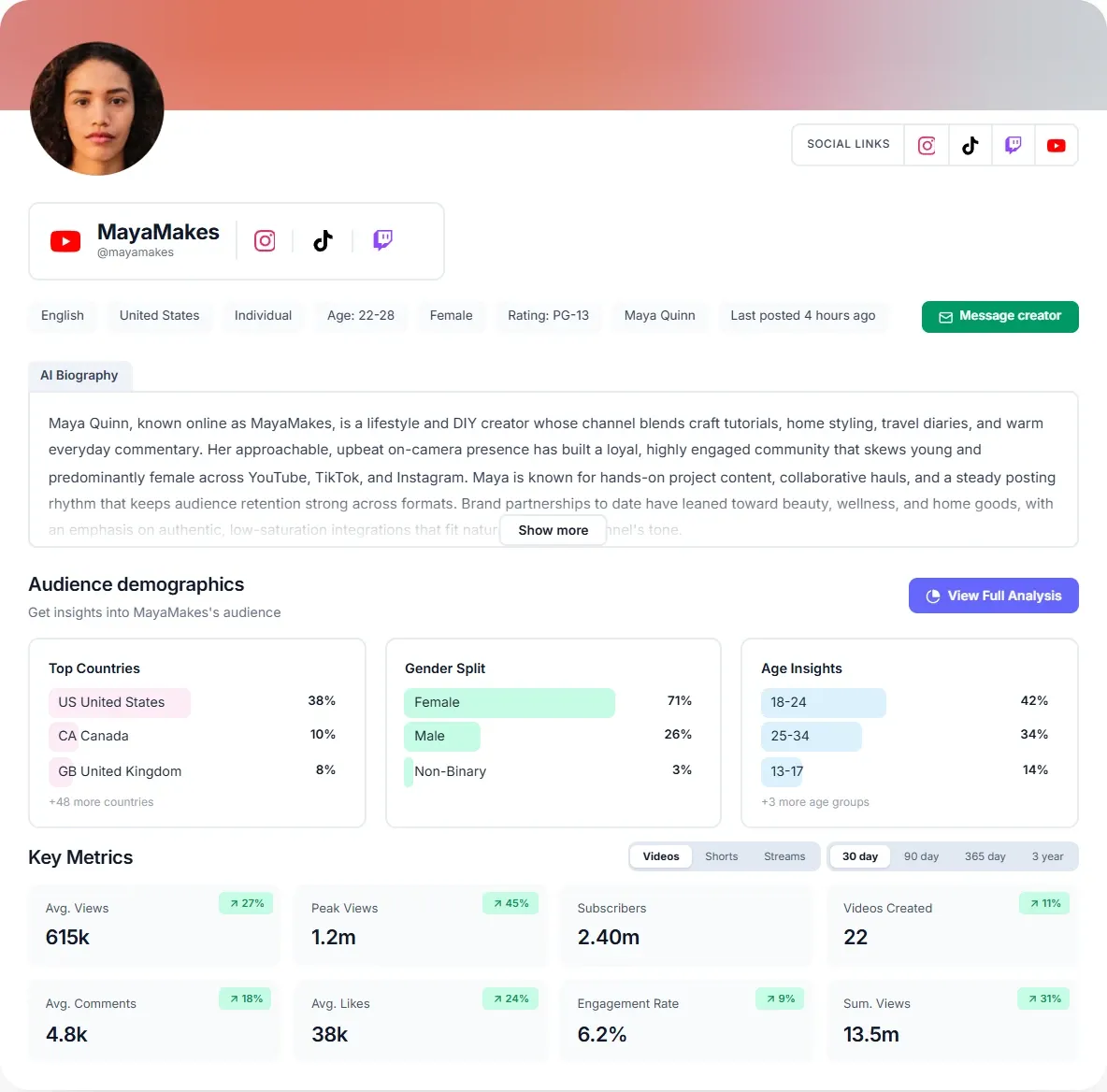
The MayaMakes demo profile places creator information, audience estimates and performance metrics in separate sections. Names and figures are sample data.
Keep creator attributes and audience attributes distinct. Creator analysis combines directly supported evidence from creator profiles, published content, and other public web sources with model-inferred qualitative details. A creator’s location or interests are therefore context for the research; they do not establish the audience’s location or interests.
Buying consideration: ask the reviewer to identify the source, date and meaning of each field used in the selection. Inspect missing values and distinguish model estimates from authenticated platform metrics. Use the data-freshness methodology when deciding whether the evidence is recent enough for the brief.
Pricing and access: Talk to Streamforge about the platforms, audience questions and research workflow you need.
2. HypeAuditor
Best for: structured Instagram demographic and audience-quality reports.
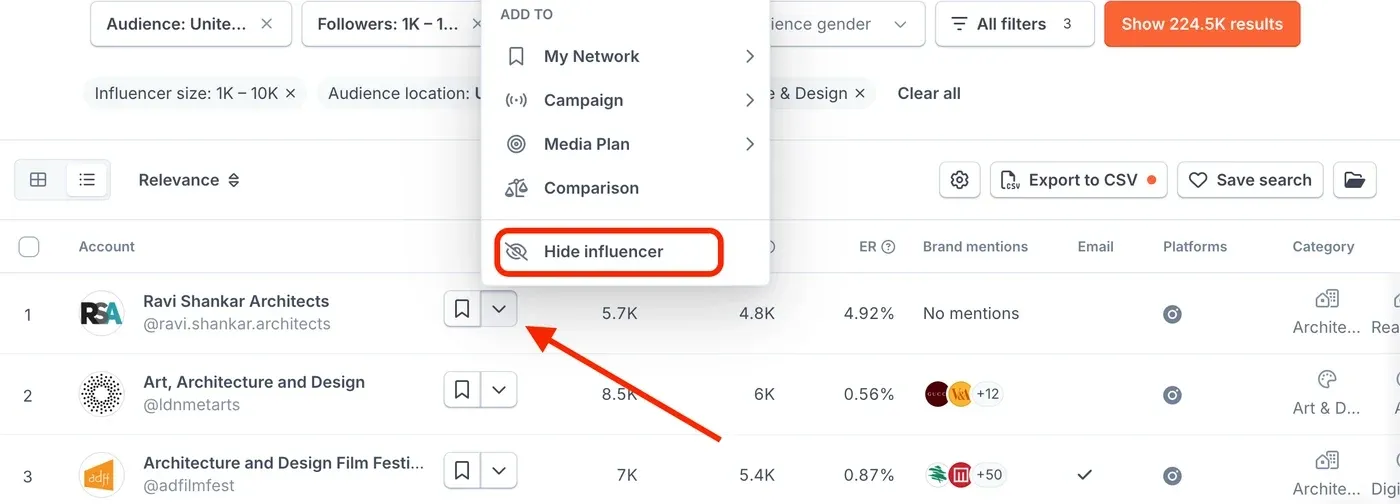
HypeAuditor’s discovery interface, annotated in its help guide. Image source: HypeAuditor.
HypeAuditor’s Instagram reporting page describes demographic breakdowns, audience interests and audience-quality signals. It is a candidate for teams that want a structured report to accompany an Instagram shortlist.
What to evaluate
- Audience age, gender and language breakdowns.
- Audience interests alongside the campaign’s category.
- Audience quality alongside demographic fit.
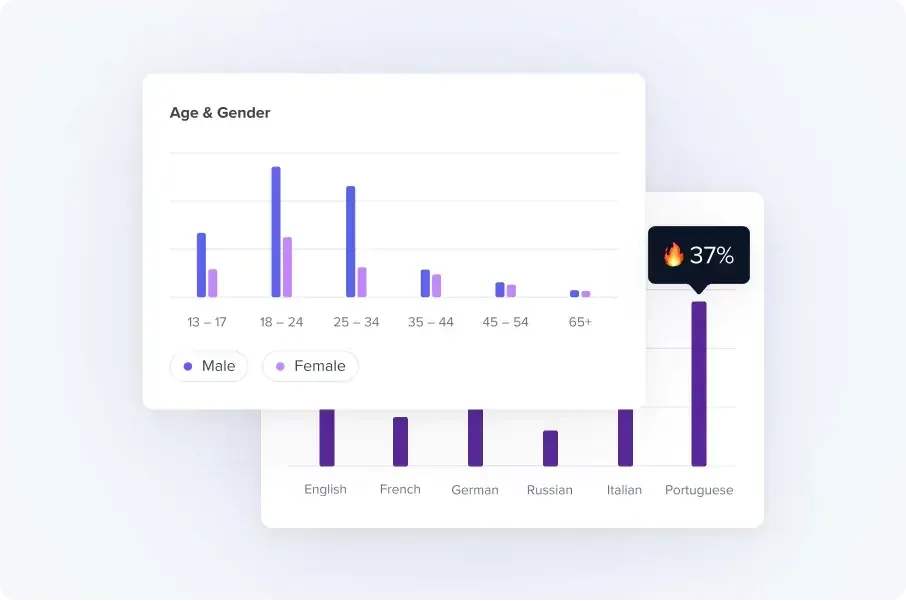
Demographic report panels published by HypeAuditor; these are product examples. Image source: HypeAuditor.
Buying consideration: check the exact field definition and platform coverage. An interest label only helps if the team can explain what evidence produced it and how it relates to the brief.
Pricing and access: Request HypeAuditor pricing for the report volume and networks in scope.
3. Modash
Best for: comparing creator performance with audience location, language and interests.
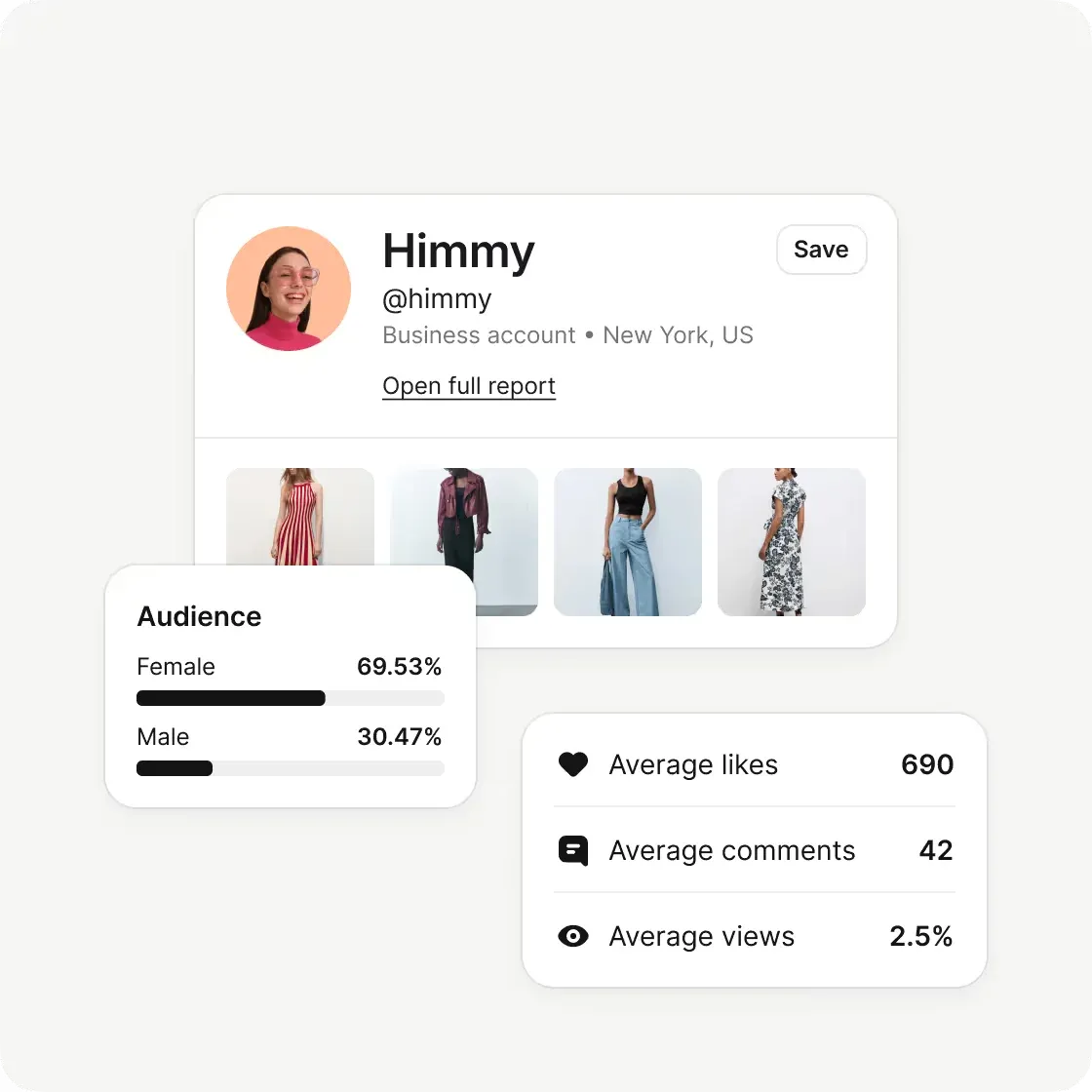
Modash’s vendor-published creator and audience analytics view. Image source: Modash.
Modash’s analytics page lists audience location, language, demographic and interest information alongside creator performance. This supports a review that considers who follows the account and how its content performs.
What to evaluate
- Audience geography and language for market-specific campaigns.
- Interests and demographic composition.
- Content performance and follower-growth context.
Buying consideration: audience fields and authenticity fields have separate coverage limits. Modash’s help documentation says fake-follower analysis is Instagram-only; TikTok and YouTube profiles do not include it. Test the complete set of fields your campaign needs on each network.
Pricing and access: Essentials is $199/month billed annually, or $2,388 for the year. Compare plans, including profile-analysis allowances.
4. CreatorIQ
Best for: adding authenticated audience data to an owned creator network.
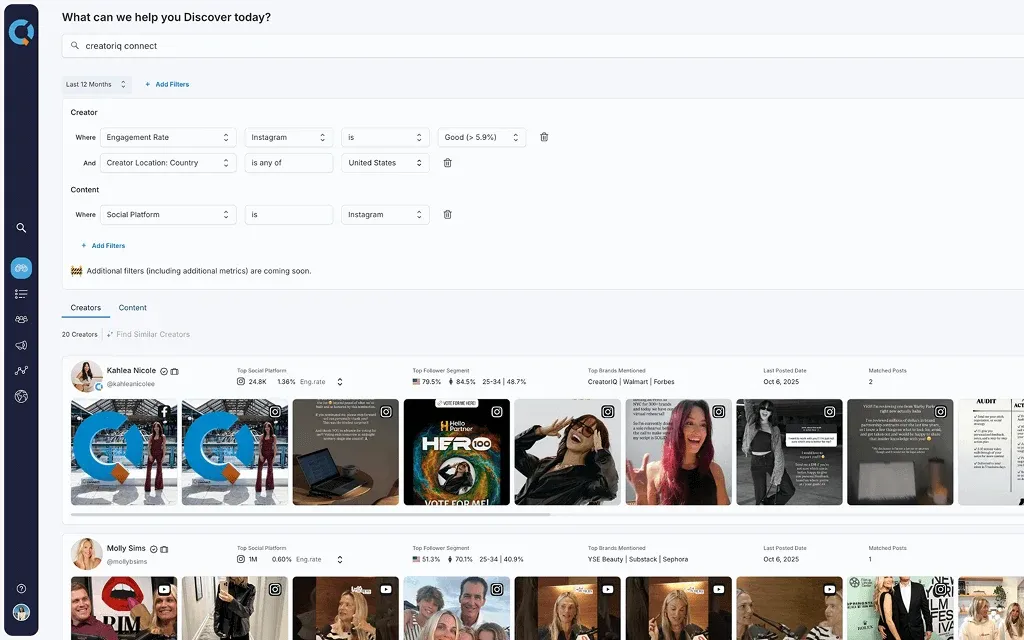
CreatorIQ’s vendor-published Discovery interface. Confirm the audience-report configuration in a current demo. Image source: CreatorIQ.
CreatorIQ’s influencer CRM page describes audience and historical performance data for creators who authenticate their social accounts. Its evaluation offering also brings demographic, engagement and content information into selection.
What to evaluate
- Authenticated audience data for participating creators.
- Demographic and engagement review during selection.
- Audience evidence retained with the creator relationship.
Buying consideration: compare a connected creator with a prospective creator who has not authenticated. Establish which fields are available in each case and what happens if the connection expires. That distinction matters when the program needs to research new candidates at scale.
Pricing and access: Request CreatorIQ pricing for your network, data connections and evaluation requirements.
5. Traackr
Best for: incorporating audience alignment into broader creator planning.
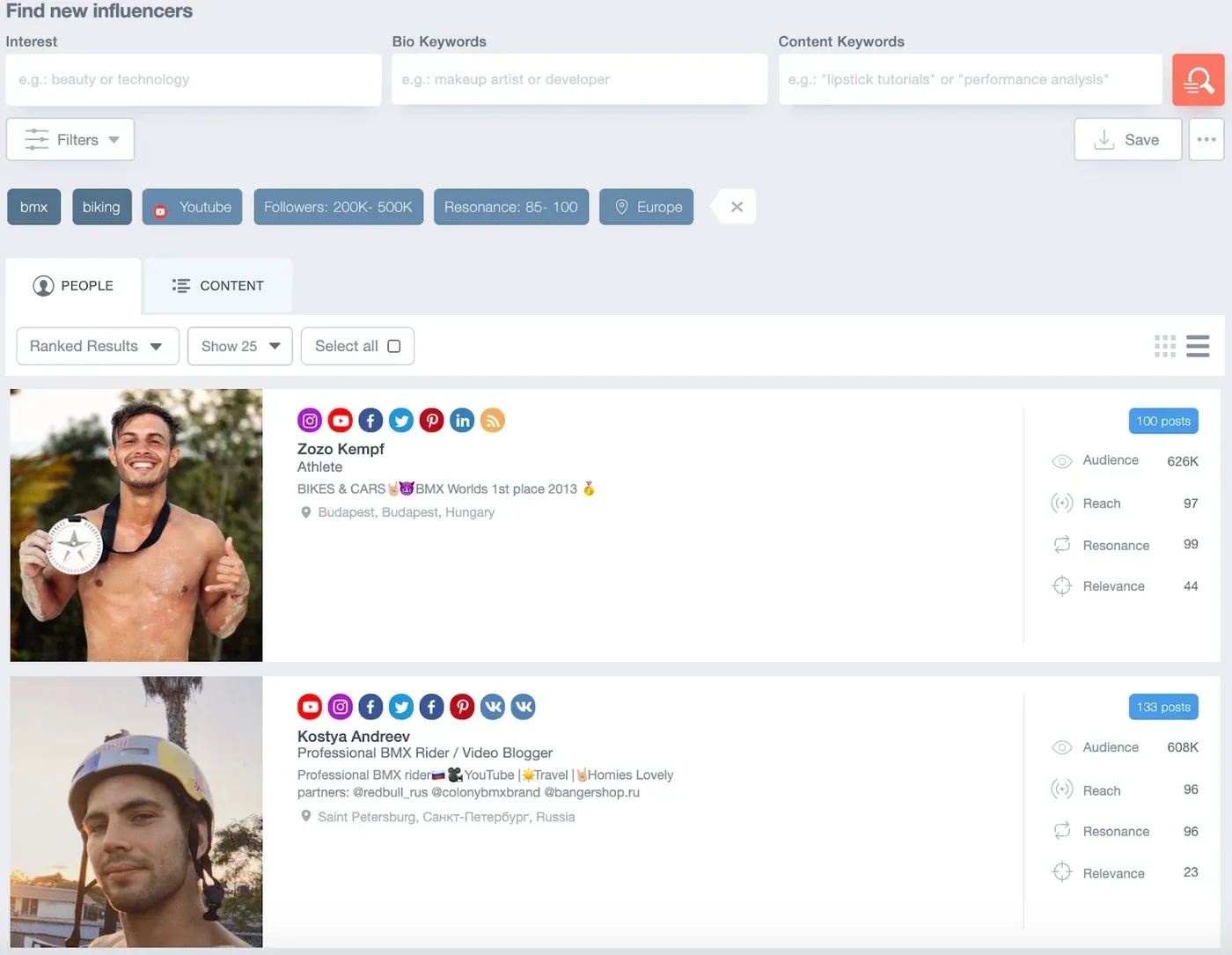
An archival Traackr search dashboard. Request the current audience-analysis view when evaluating the product. Image source: Traackr.
Traackr’s planning and discovery page includes audience alignment and audience-quality insights in its assessment process. The broader platform adds activation and measurement to that planning context.
What to evaluate
- Audience alignment during creator assessment.
- Audience-quality evidence behind the selection.
- The connection between selection criteria and program planning.
Buying consideration: bring a specific country, language and category brief. Ask the vendor to show the fields and supporting evidence that make a creator eligible, rather than evaluating the product on a generic demonstration.
Pricing and access: Request Traackr pricing for your teams, regions and program scope.
6. Influencity
Best for: evaluating a roster with audience analysis and overlap.
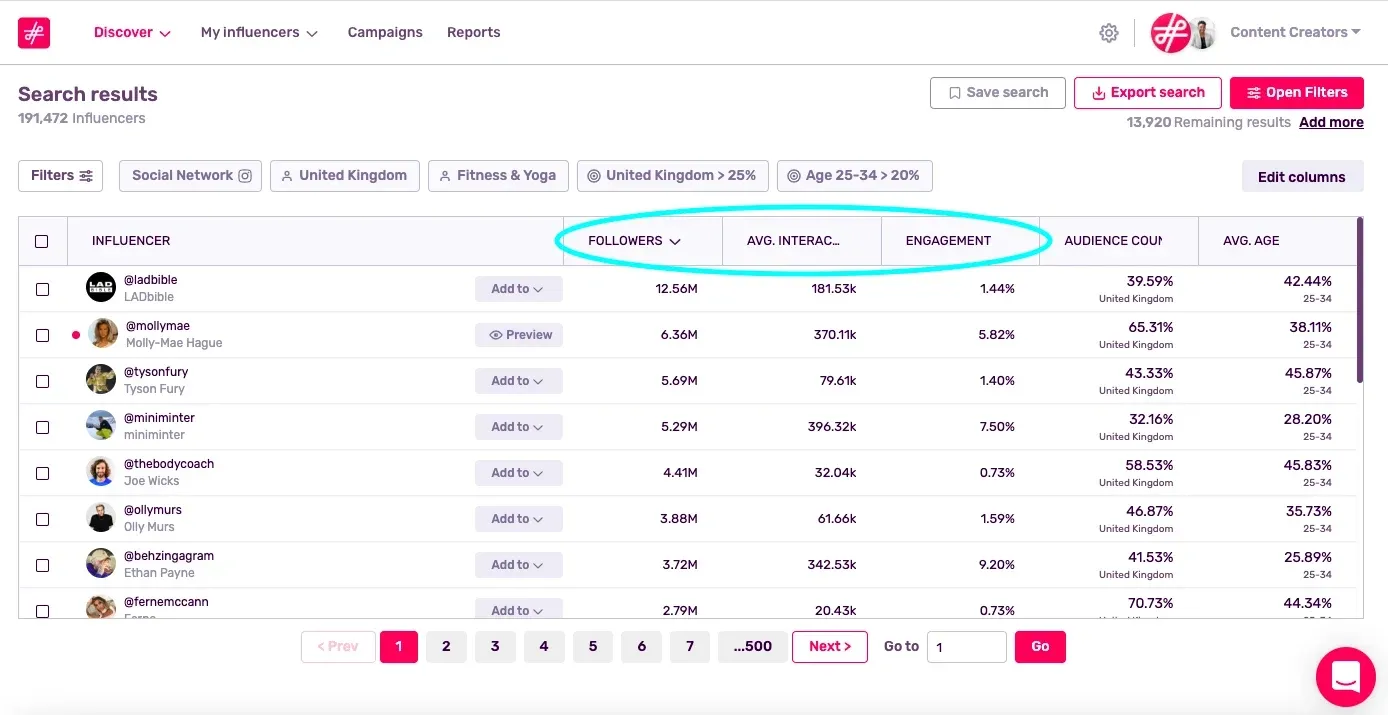
Influencity’s Discover results, annotated in its help documentation. Image source: Influencity.
Influencity’s analysis product describes audience demographics, interests, quality and overlap analysis. Overlap is especially relevant when a team is choosing several creators and needs to investigate whether their communities duplicate one another.
What to evaluate
- Audience demographics and interests for shortlisted creators.
- Audience quality and reachability indicators.
- Overlap analysis for the proposed creator roster.
Buying consideration: confirm which networks and audience fields the overlap analysis covers. Summed follower counts are not unique campaign reach, and overlap between followers does not establish who will see the sponsored posts.
Pricing and access: Compare Influencity’s monthly and annual plans, including the analysis capacity and modules your roster requires.
What audience analysis should tell your team
Use four questions to turn a report into a campaign decision. They also make a useful demonstration brief for any of the tools above.
1. Are the audience and creator being described separately?
Creator analysis describes the person and their content: subjects, style, public identity and publishing history. Audience analysis describes the community: where people are, which languages they use, their estimated demographic composition and their relationship to the subject.
For example, a creator who lives in London may have a predominantly international audience. A creator who publishes about gaming may attract viewers for their comedy rather than a particular game. Save a separate audience-fit statement for each shortlisted creator, with the evidence supporting it. The guide to audience geography and language explains the market check.
2. What does an affinity or interest label mean?
An audience affinity is a reported connection between the community and a topic, category or brand. Ask what the tool uses to produce it: audience activity, profile information, creator content, a model inference or another source. Ask whether the value is a share of the audience, a relative index or a category label.
Do not treat a relative affinity index as the percentage of people likely to buy. Record a hypothesis you can test, such as: “The audience repeatedly discusses this category, so a practical demonstration may fit the conversation.” Link the hypothesis to examples and keep the commercial outcome for campaign measurement. The psychographics guide develops this research step.
3. How credible and engaged is the community?
Review audience-quality signals together with actual discussions. Look for replies that address the content, sustained exchanges and relevant questions. Investigate repetitive patterns in context; repeated language can reflect either automation or a community’s shared joke.
Treat demographic fit, authenticity and community health as separate parts of the decision. A creator can have an apparently authentic audience that lacks relevance to the brief, or relevant viewers who rarely respond to the proposed format. For a dedicated authenticity review, use the influencer vetting tool comparison.
4. Can the team carry the hypothesis into measurement?
Before booking, save the target market, the audience-fit hypothesis, the evidence date and the important unknowns. Decide what the campaign can actually measure: category-relevant comments, site visits, conversions or another agreed response. Audience research guides selection; the campaign still needs its own measurement plan.
Choose a workflow that keeps that record accessible to the campaign manager and analyst. The creator communication guide explains the information those handoffs need.
A practical audience-analysis demo plan
Give every vendor the same brief and creator set. Include known partners whose audience evidence you can access, prospects who have not authenticated, and creators on each required platform. Use the same period when comparing reports.
For each creator, write down:
- The target audience question and the field intended to answer it.
- The source type, collection date and whether the value is observed or inferred.
- Which required fields are missing and how the team would investigate them.
- The evidence behind an interest, authenticity or community interpretation.
- The selection decision and the next action it supports.
Where a creator shares platform analytics, compare the same account, period and metric definition. Differences may reflect follower versus viewer populations, estimation, collection dates or missing data. Record those differences before drawing an accuracy conclusion. The useful tool is the one that provides enough interpretable evidence for your decision and exposes its gaps clearly.
Audience analysis FAQs
Which tool provides the most accurate influencer audience data?
There is no universal accuracy ranking established by this article. Accuracy depends on the field, source, network, population and period. Compare the relevant outputs with platform analytics shared by known creators, and ask vendors how their methods were validated for your use case.
What is the difference between creator analysis and audience analysis?
Creator analysis describes the creator and what they publish. Audience analysis describes the people following, viewing or engaging with that content, depending on the method. Keep the population definition visible: followers and viewers are not automatically the same group.
Do creators need to authenticate before their audience can be analyzed?
Some audience evidence is obtained through authenticated accounts, while other methods estimate it without that connection. Streamforge’s audience-analysis method does not require creator OAuth. Confirm the origin and availability of each field in any tool you evaluate.
What should a startup prioritize in an audience analysis tool?
Start with the campaign’s required market, language and category evidence, then add authenticity review. Test report allowances against a realistic shortlist. A smaller set of interpretable fields that supports a selection decision is more useful than a large report the team cannot act on.
Book a Streamforge walkthrough with your target market and a real shortlist to evaluate the audience evidence for your campaign.