Quick answer
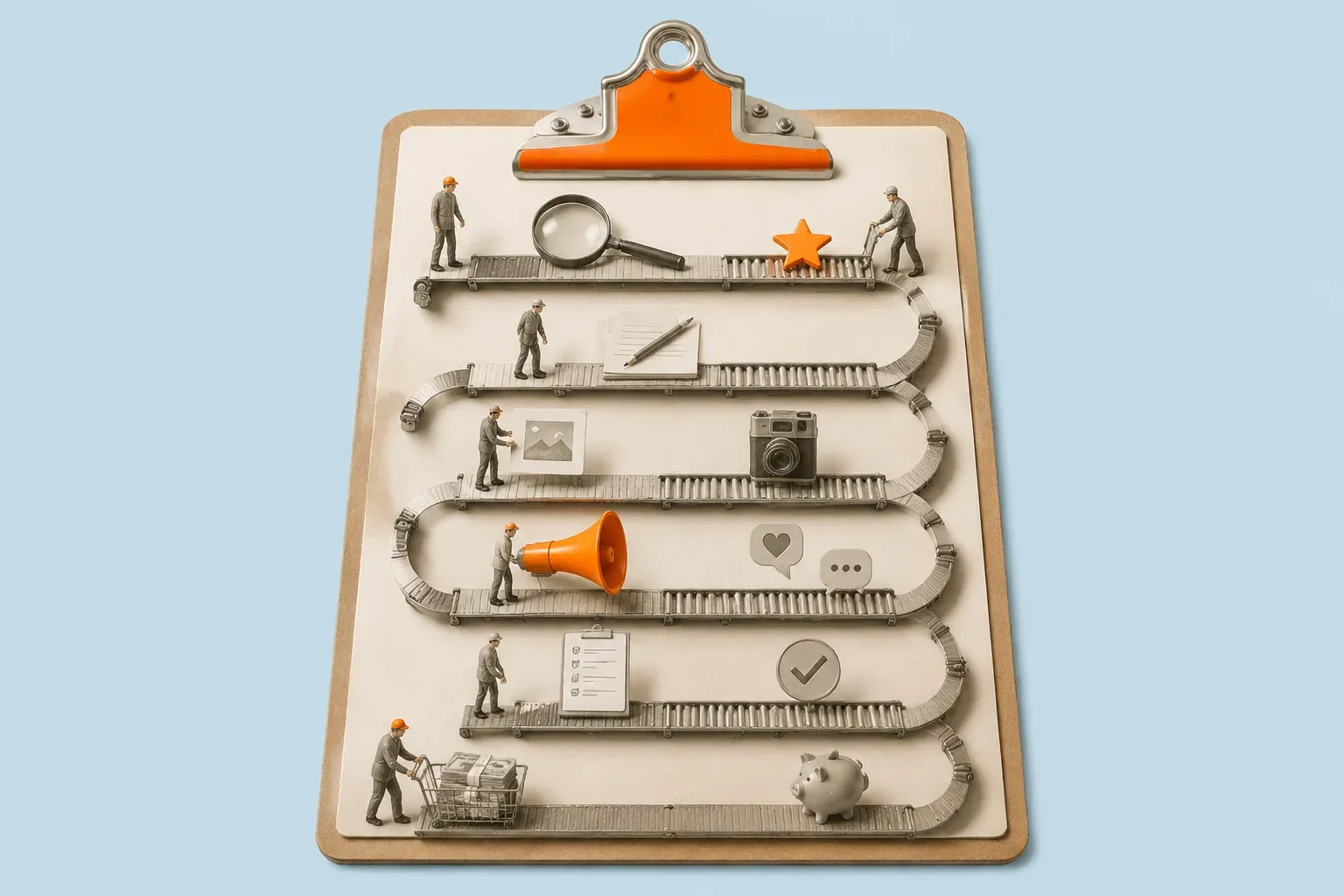
A useful influencer workflow uses stages that correspond to real decisions, not vague progress labels. Separate sourcing, vetting, outreach, negotiation, contracting, production, review, scheduling, live monitoring, reporting, and payment. Give each stage an owner and exit condition, and treat declined, paused, replaced, and canceled as explicit exception states.
Use this model when building a campaign board, CRM pipeline, project template, or handoff process for a team that manages more than a few creators at once.
What matters most
Stages should describe the current operational truth. Negotiating means commercial or contract terms remain unresolved; producing means terms are complete and the creator is making content; review means the required draft or preview is with the agreed reviewer.
A stage is not a task list. Keep the stage stable while several tasks happen inside it, and move the creator only when the defined exit evidence exists.
Exception states protect reporting. A creator who declined outreach should not look like an outreach failure forever, and a contracted creator who was canceled should not remain mixed with creators still producing.
A practical workflow
- List the decisions and handoffs in the current campaign process.
- Combine steps that share the same owner and exit evidence into one stage.
- Define required fields and artifacts for entering and leaving every stage.
- Add explicit terminal and exception states with reason codes.
- Test the model against three past campaigns and revise ambiguous transitions.
A stage is a decision, not a step
The test for whether something deserves to be a stage is whether moving out of it represents a decision somebody made. Negotiating to contracted is a decision: terms were agreed. Contracted to producing is a decision: the creator was released to start work. Brief sent is not a decision, it is a task, and making it a stage means the board now has a column that tells you an email left the building.
This is why granular pipelines decay. Every task-shaped stage adds a transition somebody has to remember to perform, and the ones that carry no decision are exactly the ones that get skipped when the campaign is busy. The board then shows a state of the world that stopped being true a week ago.
Merge anything that shares an owner and an exit condition. Fewer stages with real evidence attached to each transition produce a board people can trust, and a board people trust is one they keep current.
The pipeline must keep its dead
The instinct with a creator who declines or falls through is to remove them, because the board is for people you are working with. Deleting them destroys the only record of how the campaign actually ran.
Every planning number you will want next time comes from those records. What proportion of shortlisted creators replied. What proportion of replies became negotiations. Where the drop-off concentrated, and whether it was price, availability, category conflict or silence. Without terminal states carrying reason codes, none of that survives, and the next campaign's plan is built on the same guesswork as this one.
So use explicit terminal states with reasons: declined on price, unavailable in window, conflict, no response, brand-safety fail, canceled after contract. Cheap to record at the moment it happens, impossible to reconstruct later, and it turns a campaign into evidence rather than an anecdote.
A board only stays true if updating it is cheap
Every operations system fails the same way. The model is designed well, adopted enthusiastically, and abandoned during the first campaign that gets busy, because updating it competes with the work it describes.
Design against that directly. Reduce required fields to the ones a later decision actually depends on. Make the common transitions one action rather than a form. Accept that some fields will be filled late and design the reporting so that late is still useful. Above all, keep the number of stages small enough that the current state of any creator is obvious without reading a history.
The test is whether the board can be brought current in a couple of minutes at the end of a day. If it takes longer than that, it will not be done during launch week, which is precisely when it matters most and when everyone is instead asking each other what is happening.
Common mistakes
- Creating a separate stage for every small task.
- Using waiting as a stage without saying what or whom the team is waiting for.
- Allowing operators to skip contract or disclosure checks to make a board look current.
- Deleting declined or canceled creators instead of preserving the reason.
Working checklist
- Every stage names one accountable owner.
- Every stage has observable exit evidence.
- Waiting states include a next follow-up date.
- Declined, paused, replaced, and canceled outcomes are preserved.
- The workflow supports reporting without manual reinterpretation.
Questions and answers
How many stages should a workflow have?
As few as capture real decisions, which for most teams is a handful rather than a dozen. Each stage should answer what somebody decided to move a creator into it and what evidence proves it. Stages that describe tasks rather than decisions add maintenance without adding information and are the first ones to go stale.
What about a creator who is in two stages at once?
That usually means deliverables are being tracked on the creator record rather than separately. One creator can have a live video and a post still in review, and forcing that into a single status loses one of them. Track stage on the creator for the relationship, and status per deliverable for the work.
Should every campaign use the same workflow?
Use one model with optional stages rather than a bespoke process per campaign. Comparable stages across campaigns are what make funnel rates meaningful, and bespoke pipelines mean every campaign's numbers are its own. A gifting program can skip negotiation and contracting without needing a different model.
Who is responsible for keeping it current?
Whoever owns the relationship at that stage, updating as part of doing the work rather than as a reporting task afterwards. A board maintained by one person collecting updates from everyone else is always behind and becomes the thing people work around during the week it is needed most.
Sources and verification

Written by Nick Lombardi, Co-Founder & CTO, Streamforge. Published September 2, 2026; last verified September 2, 2026. Platform rules change, so confirm details against the primary sources below.